The app and website was publicly released on 2 Apr 2024
Update Jul 2026
New guidelines continue to be added.
The content will undergo continuous review by all our cadres.
Do use the search function on the app and website to make it easier to find relevant guidance.
Feedback on layout can be given below.
Saf [Updated 1 Jul 2026]
Meningitis
!Warning
Objectives
To guide the management of patients presenting to medical facilities with suspected central nervous system infection and meningococcal septicaemia.
Scope
This guideline outlines the initial emergency investigation and management of a person with suspected central nervous system infection.
It also covers the initial emergency investigation and management of a person with suspected meningococcal septicaemia.
Meningococcal disease is a reportable disease in England and Wales. Treating clinicians should also consider reporting requirements and public health measures that can be found in separate guidance on notifiable diseases.
Audience
This guideline is intended for the use of registered healthcare professionals fulfilling a general role in forward medical locations or in an Emergency Department on deployed operations.
Initial Assessment & Management
Recognition - Central Nervous System (CNS) infection should be considered in an unwell patient presenting with the following symptoms and signs:
Severe headache.
Neck stiffness/meningism.
High fever.
Altered mental status.
Photophobia.
Phonophobia.
Positive Kernig’s or Brudzinki sign (involuntary flexion of knee and hip on flexion of neck).
Petechial or purpuric rash in the presence of any of the above signs is highly suggestive of meningococcal meningitis with septicaemia (especially if progressive).
Assessment:
Use a structured MARCH approach
Check blood sugar and treat hypoglyaemia if present.
Check and monitor vital signs and fluid balance (using a recognised score e.g. NEWS2).
Complete a full neurological examination.
Treatment:
Administer empiric antibiotics in accordance with the current DMS antimicrobial policy if the patient has signs of sepsis or is unlikely to get a lumbar puncture within 4 hours.
Begin fluid resuscitation with crystalloids if signs of shock.
IV antivirals should be initiated if there is any suspicion of encephalitis, in accordance with the current DMS antimicrobial policy, but do not delay evacuation.
Dexamethasone 10mg IV QDS for 4 days should be started as adjunctive therapy before or up to 12-hrs after first dose of antibiotics to reduce neurological sequelae in possible pneumococcus meningitis.
Initiate urgent MEDEVAC from forward location to a facility providing deployed hospital care.
Note that casualties with reduced GCS, significant sepsis or behavioural disturbance may require an enhanced care team to support evacuation if available in the deployed setting.
If CNS infection is a possible differential and the patient is unwell, have a low-threshold to treat urgently with antibiotics, ideally within one hour.
Advanced Assessment & Management
Investigation:
Blood tests should be taken as available, including FBC, U&E, CRP, lactate, coagulation function and blood cultures (ideally prior to antibiotics).
Most deployed hospital laboratory facilities will be able to perform CSF analysis of common pathogens. Perform a lumbar puncture (LP) if these facilities are present.
Take 4 X 5ml CSF samples for analysis:
Measure CSF opening pressure (normal <25mm CSF).
CSF microscopy/Gram stain, culture, and protein.
CSF glucose and lactate (with a paired serum glucose taken at that time).
CSF bacterial and viral PCR.
The diagnostic value of LP for bacterial meningitis is reduced 4 hours after antibiotics are commenced. Perform LP as soon as is practical.
Lumbar Puncture can precipitate fatal coning in someone with raised ICP.
A routine CT brain should be conducted for all patients with suspected CNS infection where available.
Arrange urgent CT brain PRIOR to lumbar puncture and review the results before deciding if it is safe to proceed if there are:
Risk factors for an evolving space-occupying lesion.
Symptoms or signs which might indicate raised intracranial pressure:
New focal neurological features (including seizures or posturing).
Abnormal pupillary reactions or papilloedema.
Relative bradycardia with hypertension
GCS score below 10 or a progressive and sustained or a rapid fall in level of consciousness.
If CT imaging is not available or cannot be performed, do not perform a lumbar puncture if any of the above features unless on specialist advice from the infectious diseases reachback service.
Treatment:
Once within deployed hospital care, continue antimicrobial therapy in accordance with the current DMS antimicrobial policy. If prior IM antibiotic dose given, switch to IV regimen without delay - do not wait for the next dose timing.
If Encephalitis cannot be excluded IV Antivirals should also be continued in accordance with the current DMS antimicrobial policy.
If not already commenced, dexamethasone 10mg IV QDS for 4 days should be started as adjunctive therapy before or up to 12-hrs after first dose of antibiotics to reduce neurological sequelae in possible pneumococcus meningitis.
Critical Care support is commonly required and should be sought in line with standard indications.
Prolonged Casualty Care
Continue regular IV antibiotics and antivirals.
Typical antibiotic durations by pathogen are:
Neisseria meningitidis - 5 days
H. influenzae - 7–10 days
S. pneumoniae - 10–14 days
S. agalactiae - 14–21 days
Aerobic Gram Negative Bacteria (e.g. E. coli) - 21 days
Sedation may be required for agitation, see sedation CGO.
Reach back to the infectious diseases reach back service is strongly advised if possible.
Paediatric Considerations
Assess and manage children with a structured MARCH approach.
Pay careful attention to blood glucose monitoring and treat hypoglycaemia aggressively.
Administer empiric antibiotics, using weight based dosing, in accordance with the current DMS antimicrobial policy noting that there may be variations from adult regimes in specific age groups.
Steroids should not be given to children with suspected meningitis in infants <3 months of age.
Otherwise start Dexamethasone 0.15mg/kg IV QDS for 4 days as adjunctive therapy before or up to 12-hrs after first dose of antibiotics to reduce neurological sequelae in possible pneumococcus meningitis.
Clinical Features of Bacterial Meningitis
There is no single clinical feature universally identified in patients with meningitis. The table below shows the approximate likelihood of a particular clinical feature being observed in a patient who has bacterial meningitis.
Note, however, that nearly all (~95%) of patients are found to have at least two of the classic features of headache, neck stiffness, fever and reduced conscious level.
Clinical Feature
% Likelihood
Headache
87%
Neck stiffness/photophobia
83% ("meningism")
Fever ≥38°C
77%
Nausea
74%
GCS <14
69%
Symptoms <24hrs
48%
Focal neurology
33%
Rash
26%
Otitis / sinusitis
25%
Seizures
5%
95% of meningitis cases will have at least two of headache / neck stiffness / fever / GCS <14
Neck stiffness: Passively flex the patient’s neck. This test is positive if there is palpable resistance.
Kernig’s sign: Position the patients supine with their hips flexed to 90°. This test is positive if there is pain on passive extension of the knee.
Brudzinski’s sign: Position the patients supine and passively flex their neck. This test is positive if this manoeuvre causes reflex flexion of the hip and knee.
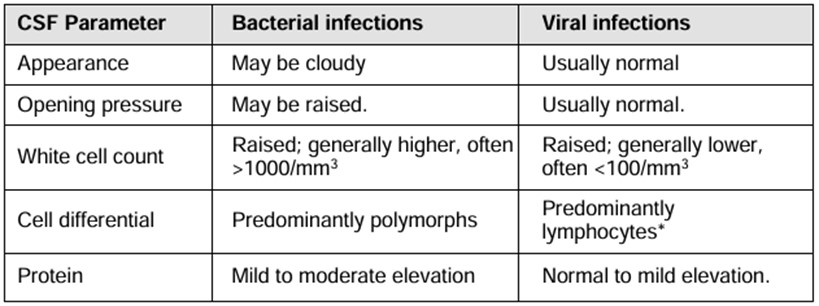
CSF Interpretation
Infectious Disease Precautions
Isolation Precautions:
Patients with suspected meningitis or meningococcal septicaemia should be immediately isolated and remain in isolation until one of the following criteria is met:
The diagnosis has been excluded, or The patient has completed at least 24 hours of appropriate antibiotic therapy.
Isolation can take the form of physical separation or designated cohorting, depending on operational constraints and facility capacity.
Personal Protective Equipment (PPE):
Level 1 PPE, including a surgical mask, should be worn by all personnel who are within 1 metre (3 feet) of a patient’s respiratory secretions, particularly prior to 24 hours of antibiotic therapy. This is critical during:
Resuscitation
Airway management
Clinical assessments involving close contact
The infection prevention and control team can be contacted on Pando ‘IPC’.
Post-Exposure Prophylaxis (PEP)
Healthcare staff involved in the care of a confirmed meningococcal case should be assessed for prophylaxis if they were:
Exposed to respiratory secretions (e.g., intubation, suction)
Not wearing appropriate PPE during exposure
Prophylaxis decisions should be made in consultation with UKHSA (UK Health Security Agency) or Infectious diseases via secure platform (e.g. Pando)
Common regimes include single dose Ciprofloxacin 500mg PO or Ceftriaxone 250mg IM