
Update Jul 2026
New guidelines continue to be added.
The content will undergo continuous review by all our cadres.
Do use the search function on the app and website to make it easier to find relevant guidance.
Feedback on layout can be given below.
Saf
[Updated 1 Jul 2026]
This guideline describes the structured approach to the initial assessment and management of an injured casualty in the operational setting.
What is the initial approach to the injured casualty in the resource-poor environment including pre-hospital emergency care?
What is the initial approach to the injured patient in the better resourced environment including medical treatment facilities?
How are life-threatening conditions identified and managed in order of priority?
How are clinical, tactical and logistical factors taken into account to maximise safety, make best use of available resources and deliver optimal clinical effect?
This CGO offers a framework and broad principles for assessment and management of injured casualties; specific conditions will be covered in the relevant CGOs.
This CGO does not detail the initial triage and management of multiple casualties
This guideline is intended for use by registered healthcare professionals in the pre-hospital environment, forward medical facility or emergency department on deployed operations. The capability of the individual, team and facility will determine the extent to which these guidelines can be implemented.
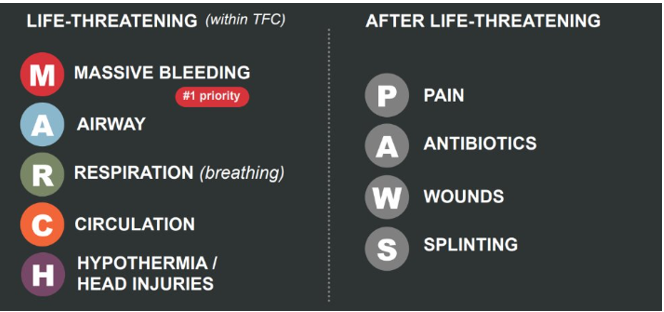
The initial approach will be based on the Tactical Trauma Assessment (TTA) as described in the United Kingdom version of Tactical Combat Casualty Care (TCCC(UK)). The TTA is modified depending on the level of provider and the tactical situation, but in all cases remains based around the “MARCH PAWS” algorithm:
The immediate priorities depend on the tactical situation.
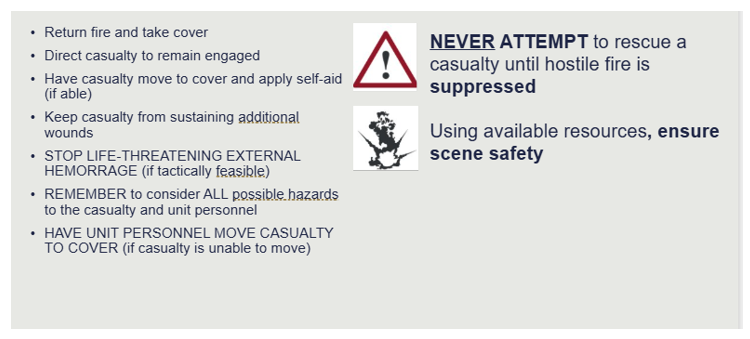
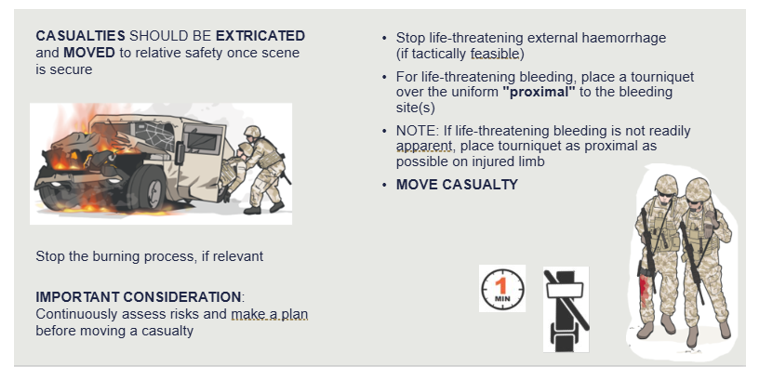
During Care Under Fire/threat (CUF) the priority is maintaining the safety of the unit and medical management must not take precedence over tactical survival (See accordion content). Medical assessment and interventions are limited to control of massive haemorrhage from limbs. If the casualty cannot be safely reached this is achieved through self-aid. If life-threatening limb haemorrhage is identified the patient should be encouraged to apply a tourniquet, move to a place of safety and return fire if possible. If the casualty can be safely reached, they should be extricated from immediate danger (such as a burning vehicle) and, if a life-threatening bleed is identified on a visual blood sweep, a tourniquet applied. This, by necessity, may be over clothing or “high and tight”; the casualty should then be moved to the best available cover.
Once in the Tactical Field Care (TFC) phase a full TTA should be completed aiming to identify and manage life-threatening injuries in the order most likely to kill the patient:
|
NOTE:
|
1. If Traumatic Cardiac Arrest identified at any stage follow TCA CGO 2. If analgesia or hypothermia is likely to be an issue and can be easily addressed without undue delay this can be initiated at any stage |
|
M – Massive Haemorrhage
|
Reassess all tourniquets placed during CUF Conduct a full blood sweep If further tourniquets required, ensure these are “deliberate tourniquets” placed directly to skin 2-3” above the wound Treat any life-threatening junctional haemorrhage with direct pressure, haemostatic gauze and pressure dressings |
|
A - Airway
|
Assess the airway. If casualty is conscious, talking and no airway injury move on Manage airway obstruction in a structured fashion to available skill set: Suction / manual clearance of foreign material, patient positioning (position of comfort or recovery position), airway manoeuvres (head tilt/chin lift or jaw thrust), airway adjuncts (nasopharyngeal, oropharyngeal or supraglottic airway) or definitive airway (intubation or surgical airway CGO |
|
R -Respiration
|
Assess respiration using structured algorithm (WORSEN FLaP or similar) If open pneumothorax identified apply chest seal If tension pneumothorax identified decompress affected side using needle decompression or thoracostomy Apply oxygen if available and saturations <94% |
|
C - Circulation
|
Reassess Massive Haemorrhage interventions Assess for evidence of hypovolaemia - if identified, gain intravenous or intraosseous access and resuscitate ideally using warmed blood products Administer 2g of TXA if IV/IO access available or 1g IM if not available followed by further 1g once IV/IO access obtained Administer 10mls of 10% calcium chloride if blood products given Identify any further significant but not life-threatening bleeding sources and pack/dress wounds as required Apply a pelvic binder if indicated Assess all torniquets: If required ensure all are deliberate tourniquets as per TCCC(UK) Tourniquet Replacement guidance
If not required follow TCCC(UK) Tourniquet Conversion guidance |
|
H – Hypothermia / Head Injuries
|
Assess for evidence of head injury and reduced consciousness (using AVPU) or abnormal neurology Check blood glucose if monitor available Prevent hypothermia through removal of wet clothing, use of insulating material and initiation of available passive or active warming methods |
|
P -Pain
|
Assess and manage pain. If the casualty has minor injuries and can remain operationally effective, administer the Individual Medication Pack (IMP). If the casualty has severe pain follow fentanyl, morphine or ketamine guidance within scope of practice |
|
A - Antibiotics
|
Administer IMP for all open combat injuries Consider broad spectrum antibiotics for significant open wounds as per deployed formulary |
|
W - Wounds
|
Address any further wounds with dressing and removal of gross contamination where possible. This includes eye injuries. |
| S - Splinting | Splint any injuries and, if appropriate, package patient. Whilst cervical spinal considerations should not take precedence over the preceding elements of the TTA, it is appropriate to consider precautions at this stage. |
The TTA is designed to be conducted by a single medical provider which is likely to be the case in the pre-hospital environment (including Medical Evacuation), forward medical location or any facility receiving multiple casualties. Whilst more advanced elements may be introduced (such as advanced analgesia, blood products or early surgical interventions), the basic components of the TTA should remain the focus at all times.
Following completion of the initial TTA all significant findings should be documented including timings of tourniquets and medications before being communicated as required including generation of a 9-line request if evacuation is planned. Any patient deemed not fit to return to operational duties will now take one of the following paths:
a) In the pre-hospital or forward medical location:
i) Awaiting Tactical Evacuation (TACEVAC)
ii) Prolonged Casualty Care (PCC)
b) In the deployed medical treatment facility:
i) Awaiting TACEVAC
ii) Awaiting further treatment (including surgery)
iii) Prolonged Casualty Care (including ward-base care)
In all cases, the principles of casualty monitoring apply with regular assessment of MARCH PAWS, documentation of findings, management and effects of interventions and creation of a patient management plan. Specific management considerations include:
Management of injured patients in better resourced facilities may include:
If at any stage prior to ward-based care the patient deteriorates a TTA should be conducted with interventions as required