
Surgical decision making in deployed surgery
Objectives
To provide practical guidance for deployed surgical teams on how to make safe, defensible, and context-aware decisions about whether to operate, when to intervene, whom to prioritise, how to deliver surgery with the resources available, and what operation is most appropriate. The guideline aims to improve patient benefit, reduce futile or unsafe intervention, support team coherence under pressure, and align surgical action with the realities of the operational environment.
Scope
These guidelines are for deployed clinicians who manage patients who require surgery in conflict, near-conflict, and other austere environments. They address the practical factors that drive peri-operative decision making across five linked domains: whether to operate, when to operate, who should be treated first, how surgery should be delivered given available people and resources, and what procedure should be performed. They cover pre-operative thresholds, prioritisation, intra-operative adaptation, and immediate post-operative disposition. The guidance is intended to complement, not replace, injury-specific CGOs and local command, evacuation, and critical care plans.
Audience
All clinicians within the deployed setting who may influence surgical decision making or peri-operative care, including surgeons, anaesthetists, critical care clinicians, emergency physicians, nursing staff, operating department practitioners, peri-operative practitioners, commanders with medical oversight responsibilities, and planners responsible for evacuation, blood support, and surgical capability.
Initial Assessment & Management
Key Principles
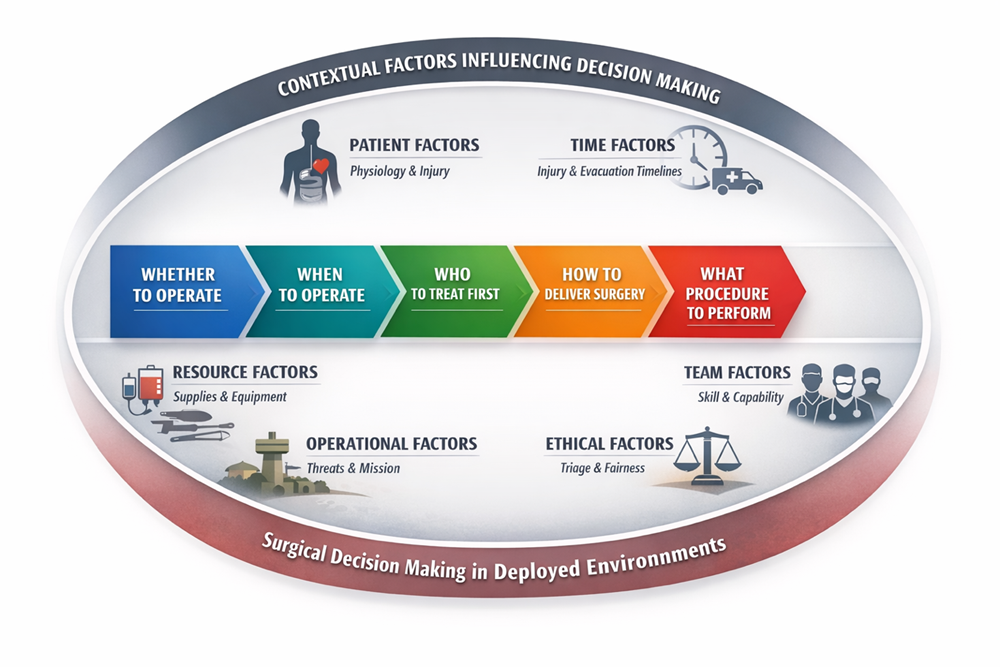
In deployed surgery, decision making should be framed around five practical questions: should this patient have an operation, when should that operation occur, does this patient take priority over others, what operative approach can the current team and system safely support, and which procedure is most appropriate in this environment. The answer to each question depends on the interaction between patient physiology and injury, available resources, team capability, evacuation and postoperative options, and the wider operational context. Good surgical decision making in operations is therefore not simply choosing the technically correct operation, but choosing the most appropriate intervention for this patient, at this time, in this setting.
1. Whether to operate
The first decision is whether an operation should be undertaken at all. This requires assessment of whether surgery is likely to provide meaningful benefit in the context of the patient’s physiological state, injury burden, expected reversibility, and the support the system can provide before, during, and after surgery. The surgeon must balance the possibility of benefit against the risk of futility, the burden on scarce resources, and the opportunity cost to other casualties. Diagnostic uncertainty may also influence this threshold, particularly where further investigation would consume time or resources without materially changing management.
Key practical considerations include:
· probability of survival
· likelihood of meaningful functional recovery
· degree of physiological derangement
· diagnostic certainty
· resource burden of proceeding
· can surgery realistically alter outcome in the current setting
2. When to operate
If surgery is indicated, the next decision is timing. Some patients require an immediate operation because haemorrhage, contamination, or evolving physiology cannot be controlled by non-operative means. Others may benefit from a period of resuscitation, reassessment, observation, or diagnostic clarification before theatre. Timing decisions therefore depend on balancing the harm of delay against the harm of operating before the patient or system is ready. In deployed care this calculation is further shaped by evacuation timelines, blood availability, operating room cycling, and the likely consequences of postponement.
Key practical considerations include:
· whether there is an immediate life threatening problem only surgery can address
· whether the patient can tolerate further resuscitation or observation
· whether delay is likely to improve or worsen outcome
· availability of blood, theatre, anaesthesia, and postoperative support
· the effect of operating now on other patients requiring care
3. Who should be treated first
When several patients require surgery, prioritisation is essential. This is not simply a matter of treating the sickest patient first. In austere and conflict environments, priority must be informed by urgency, salvageability, resource requirement, expected duration of surgery, postoperative dependency, and the likely effect of one decision on the care of all remaining casualties. Prioritisation may also be influenced by wider operational imperatives, including force preservation, maintenance of service capacity, or humanitarian need.
Key practical considerations include:
· urgency versus likelihood of benefit
· expected blood and equipment consumption
· anticipated theatre time
· need for postoperative critical care
· consequences of delay
· the impact of one patient’s treatment on the wider casualty cohort
4. How surgery should be delivered
Once the decision to operate has been made, the means of delivering surgery must be matched to what the team and system can safely support. Resource and team constraints are cross cutting influences on all domains and may alter the operative approach directly. The same pathology may require different management depending on available personnel, anaesthetic capability, equipment, blood products, imaging, security, and postoperative care capacity. In practice, the question is not only how the operation is ideally performed, but how it can be delivered safely and effectively in the setting that exists.
Key practical considerations include:
· team composition and experience
· availability of anaesthesia and perioperative support
· equipment and consumables
· blood and resuscitation capability
· security and environmental constraints
· ability to monitor and support the patient after operation
· whether surgery should be abbreviated or staged
5. What procedure should be performed
The final decision is the specific nature and extent of the procedure. In deployed surgery, this often requires selecting the most appropriate operation rather than the most definitive one. Surgeons may need to choose between damage control and definitive surgery, repair and resection, limb salvage and amputation, or stabilisation and onward transfer. The chosen procedure must be one that the team can perform reliably and the system can support through recovery, evacuation, and any likely reintervention. Intraoperative adaptation should be expected where findings differ from preoperative assumptions or where environmental limits dictate a change of plan.
Key practical considerations include:
· damage control versus definitive intent
· technical complexity
· duration of procedure
· need for specialist equipment or implants
· tolerance of postoperative complications
· need for reintervention
· whether the procedure remains appropriate if evacuation is delayed or critical care is
limited
Advanced Assessment & Management
Cross Cutting Factors
The five decision points are linked and should always be interpreted considering a common set of cross cutting influences. These are:
1. Patient factors- Physiology, injury burden, comorbidity, nutritional state, and likely trajectory without intervention.
2. Time factors- Time since injury, rate of deterioration, time required for optimisation, duration of surgery, and time to evacuation or handover.
3. Resource factors- Blood products, imaging, surgical equipment, theatre access, consumables, critical care, and postoperative monitoring capacity.
4. Team factors- Experience, technical capability, non technical skills, fatigue, communication, and familiarity with the required procedure.
5. Operational factors- Threat environment, supply chain reliability, facility security, casualty load, evacuation uncertainty, and strategic or humanitarian priorities.
6. Ethical factors- Futility, proportionality, distributive justice, and the tension between best care for one patient and best use of finite capacity across many.
Prolonged Casualty Care
In prolonged casualty care, surgical decision making should place greater weight on the expected trajectory after the operation, not just the immediate technical feasibility of the procedure. Key considerations include anticipated delay to evacuation, duration of ongoing monitoring required, blood and oxygen sustainability, analgesia and sedation needs, nursing burden, infection control, ability to manage complications or repeat operations, and whether definitive care can realistically be supported after surgery. In this setting, a smaller or staged operation that controls haemorrhage, contamination, or pain and preserves future options may be preferable to an ambitious definitive procedure that cannot be safely supported.
Paediatric Considerations
For children, the same decision domains apply but thresholds and risk tolerance may differ. Surgical teams should account for age-specific physiology, smaller circulating blood volume, temperature vulnerability, limited paediatric equipment and drug formulations, safeguarding issues, and the availability of clinicians experienced in paediatric anaesthesia, surgery, and post-operative care. Where paediatric expertise or support systems are limited, the decision to operate should explicitly consider whether the team can safely rescue deterioration after the procedure. Damage-control principles remain valid, but decisions should be especially deliberate because both under-treatment and over-treatment may have disproportionate consequences in children.