
Soft tissue infection requiring surgery
Objectives
To provide guidance for (a) the indications for surgical drainage of soft tissue infection in order to return personnel to their primary role and (b) the management of life-threatening necrotising soft tissue infection in a deployed setting.
Scope
These guidelines are for deployed clinicians who manage patients who require surgical consideration of both simple and life-threatening soft tissue infection.
1. Features of necrotising fasciitis versus abscess.
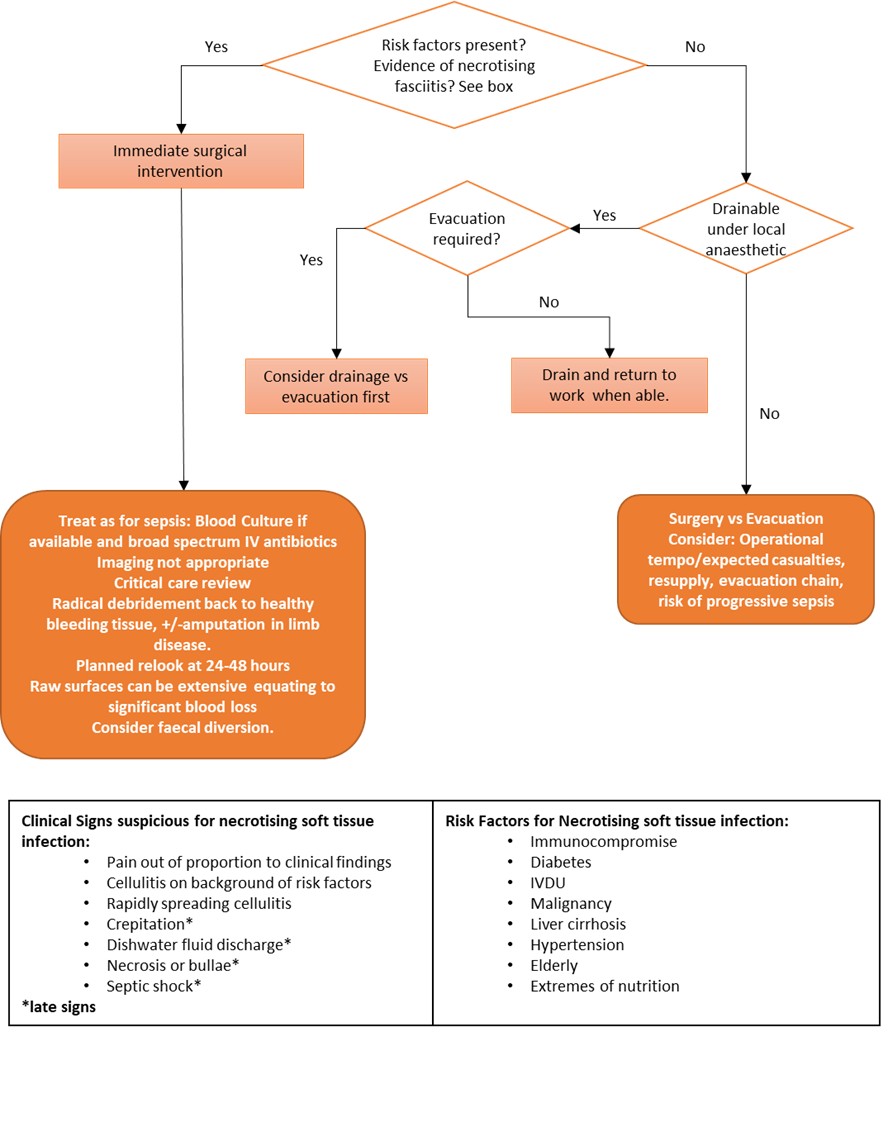
2. Decision making in the management of soft tissue infection (including non-operative management).
3. Intra-operative approach to management of soft tissue infection.
Audience
This guideline is intended for the use of registered healthcare professionals fulfilling a general role in a forward medical location or in an Emergency Department or ward on deployed operations.
Initial Assessment & Management
Initial assessment and management within the deployed setting should follow MARCH or equivalent approach.
Prolonged Casualty Care
If simple infection exists and could wait for evacuation the risks of surgical drainage (including use of limited resources) needs to be balanced with relief of pain for the patient.
Life threatening infection must be treated with urgent surgical debridement and broad spectrum antibiotics. Re-look surgery should be undertaken to ensure no further infection spread during prolonged casualty care.
Paediatric Considerations
Management of soft tissue infection in paediatrics is the same for adults, but less likely to be performed under local anaesthetic for simple abscess.
Early involvement of plastic surgeons after major debridement to consider scar tissue on future growth, particularly over flexor surfaces.