
Small bowel obstruction
Objectives
To provide guidance to deployed clinicians on the assessment and management of casualties presenting to a medical facility with small bowel obstruction. Specifically this will provide guidance to determine patients who require emergency surgery in the deployed setting and those where initial conservative management is appropriate.
Scope
These guidelines will cover initial assessment, conservative management and surgical decision making.
Audience
This guideline is intended for the use of registered healthcare professionals fulfilling a general role in a forward medical location or in an Emergency Department on deployed operations.
Initial Assessment & Management
History and examination
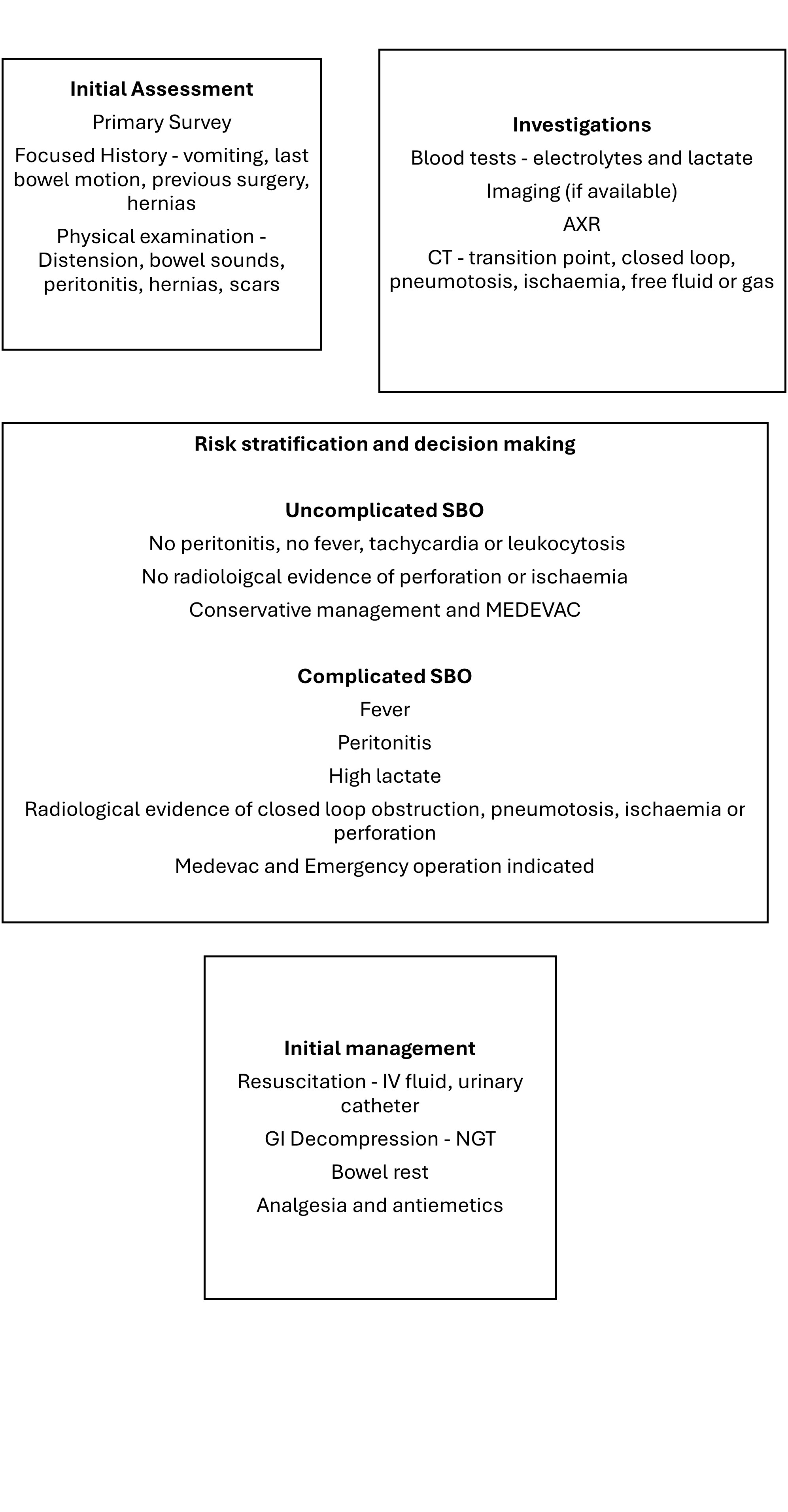
Once the clinical diagnosis of small bowel obstruction is suspected on the basis of history, the initial assessment should aim to establish the appropriate treatment pathway.
Clinical examination should assess volume status and guide fluid resuscitation. Abdominal examination should assess presence of scars from previous surgery, degree of distension, presence of hernias (incisional, abdominal wall, inguinal and femoral).
Investigations
Blood tests are required to assess evidence of infection and metabolic compromise. Imaging is a key component of diagnosis and surgical decision making. Depending on the medical facility deployed, initial investigations may vary. Plain abdominal x-ray will be able to diagnose small bowel obstruction. CT scan is diagnostic and can provide information about the level of obstruction and underlying cause.
Surgical decision making
If there is physical and metabolic evidence (lactate) of an acute abdomen then bowel ischaemia and/or perforation should be suspected. CT imaging will provide evidence of ischaemia, perforation or closed loop bowel obstruction. If such complications of SBO are identified appropriate resuscitation and surgical management should be initiated.
Initial resuscitation will include, IV fluids, IV antibiotics, Nasogastric tube decompression, catheter placement and liaison with the critical care team with preparation for emergency surgery.
If there is no evidence to indicate an acute abdomen conservative management can be initiated.
Advanced Assessment & Management
Conservative management
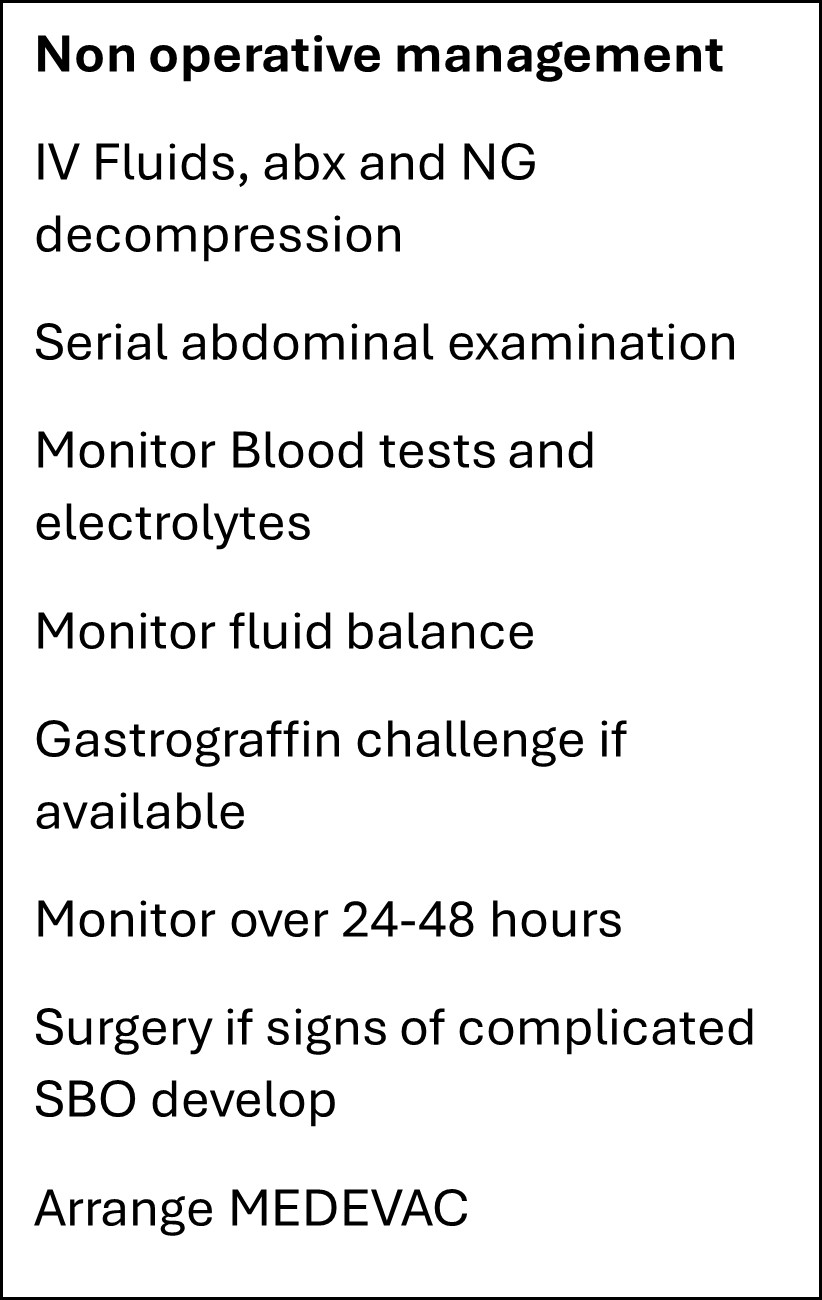
Conservative management should be initiated if there is no evidence of obstructing hernia, the diagnosis is likely to be adhesion small bowel obstruction and there is no evidence of peritonitis.
Conservative management includes IV fluid, gut rest, fluid and electrolyte balance and analgesia. Water soluble contrast is an effective stimulus and will often resolve obstruction related to adhesions but will not be available in all deployed settings.
When uncomplicated SBO is diagnosed initially and conservative management is appropriate, MEDEVAC should be arranged due to the potential requirement for imaging and surgery.
Surgical management
Surgery is considered when conservative management fails. This is determined by ongoing symptoms of obstruction with high output from NG tube or development of peritonitis and clinical deterioration.
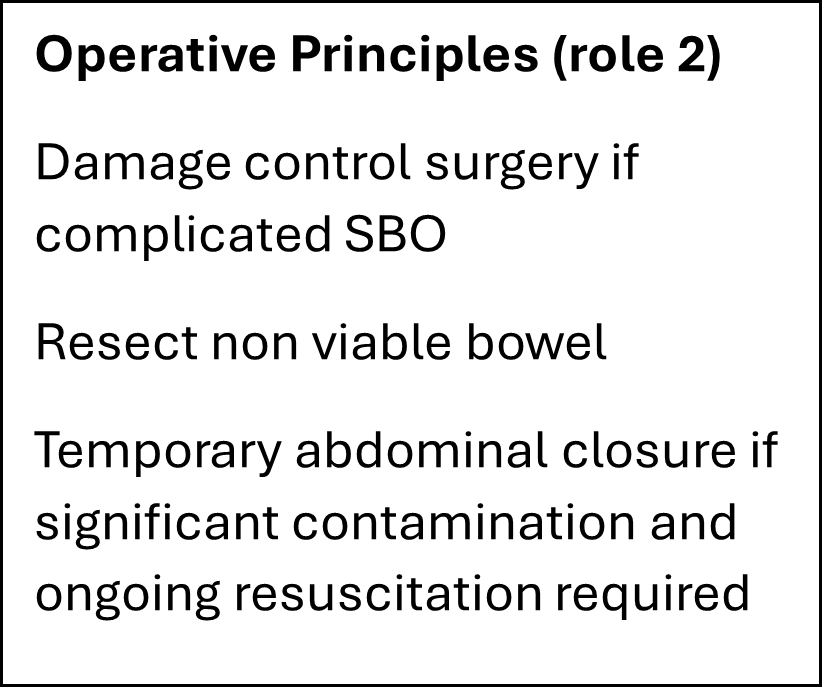
If the decision is made to undertake surgery, the medical facility must have DCS and critical care capability and post operative holding capacity. If DCS is not available then MEDEVAC is required when SBO is suspected or diagnosed.
Emergency laparotomy will be undertaken to resect ischaemic or perforated segment of bowel. Decision to undertake anastomosis will depend on overall condition of the patient.
Prolonged Casualty Care
Following surgery patients will require ongoing organ support with IV fluid supplementation. Oral intake and nutrition can be implemented over a period of days assuming bowel integrity remains. Deployed medical facilities with limited critical care capabilities should ensure MEDEVAC in place following surgery once stability for transfer established.
If unable to MEDEVAC from role 1 continue non-operative management. Signs of peritonitis give antibiotics.
Paediatric Considerations
Paediatric small bowel obstruction requires specialist paediatric competencies. If operational activity permits, initial resuscitation should be commenced. Life saving surgery should only be attempted if no host nation facility within appropriate timeline and appropriate skills present within deployed surgical team. Otherwise MEDEVAC to host nation facility is advised.