
Selective non-operative management for abdominal trauma
Objectives
This Clinical Guideline for Operations is designed to aid the deployed surgical team to decide which patients may be suitable for a selective non-operative management strategy following abdominal trauma.
Scope
This CGO covers the decision-making algorithm for patients who may be managed by selective non-operative management following abdominal trauma.
Audience
This guideline is intended for the use of registered healthcare professionals fulfilling a general role in a forward medical location or in an Emergency Department or ward on deployed operations.
Initial Assessment & Management
It should be noted that non-operative management for abdominal trauma must be carefully considered and is unlikely to be used for combat casualties, especially penetrating injuries. Patients with minor blunt trauma may be considered in very specific circumstances (including the availability of cross-sectional imaging and an ICU).
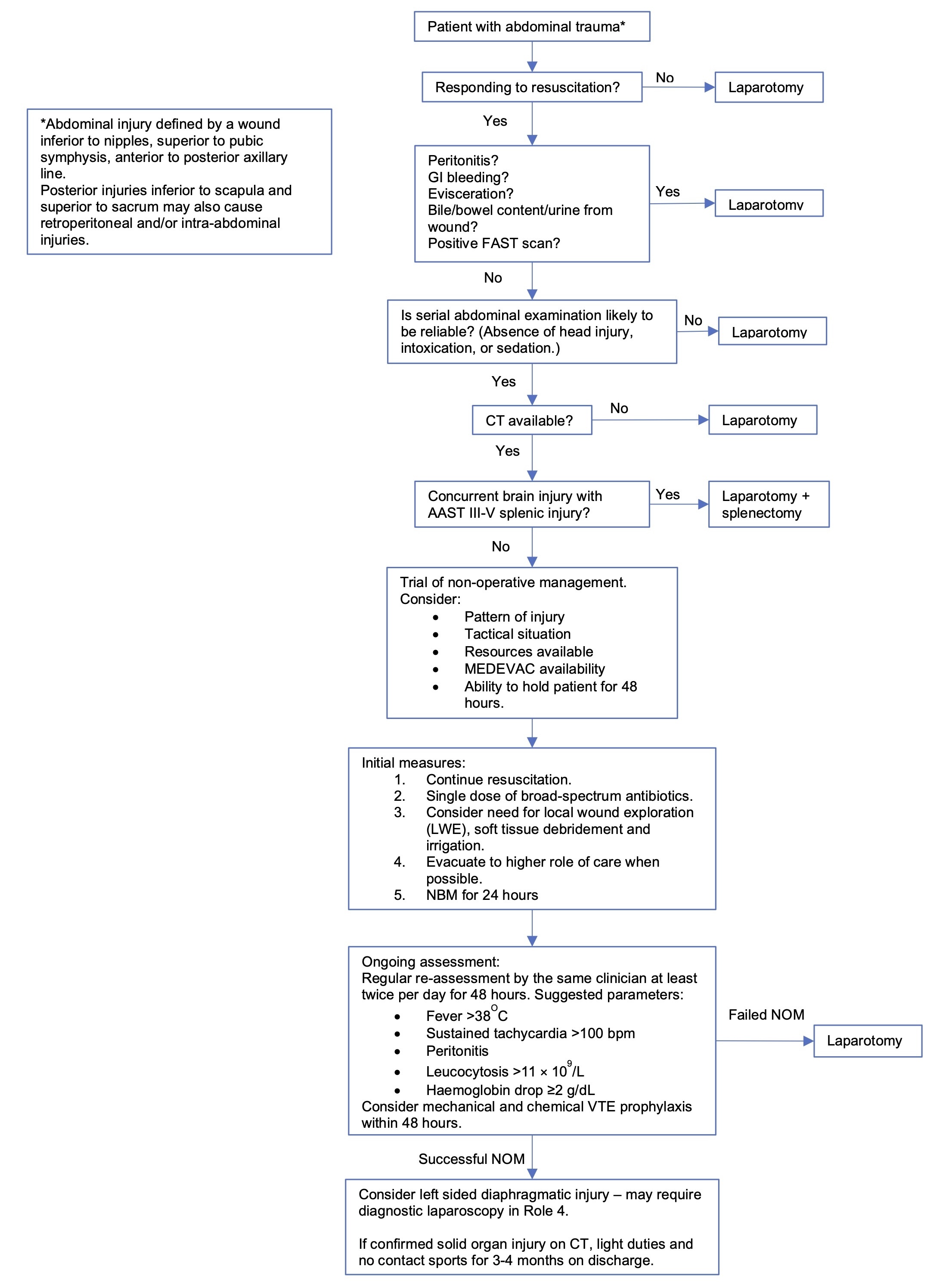
There are some trauma patients with abdominal injuries who may be suitable for selective non-operative management (SNOM). The decision-making algorithm primarily depends on the clinical signs (such as peritonitis or signs of bleeding), injury factors (such as mechanism of injury and concurrent injuries) and availability of resources and logistics.
It is important to note that patients managed by SNOM should be monitored carefully for any signs of deterioration that might require surgical intervention. Management by SNOM is an active rather than passive management strategy.
The following algorithm should be used to determine which patients may be suitable for this management.
Prolonged Casualty Care
SNOM is by definition an active monitoring of patients over several days, and commits the patient and clinicians to care in the same location, since transfer would be high risk.
Paediatric Considerations
Although the considerations are the same, it should be noted that SNOM commits several days of care for patients and clinicians must first ensure that all criteria in the eligibility matrix are fulfilled prior to instigation.