
Hernia (inguinal, umbilical, abdominal, incisional)
Objectives
To provide guidance for (a) decision making in symptomatic hernia disease and (b) surgical options for repair and considerations in the deployed setting that differ from NHS care.
Scope
These guidelines are for deployed clinicians who may be required to diagnose and manage hernias. Including decision making for safe evacuation or deployed surgical repair.
Audience
This guideline is intended for the use of registered healthcare professionals fulfilling a general role in a forward medical location or in an Emergency Department or ward on deployed operations.
Initial Assessment & Management
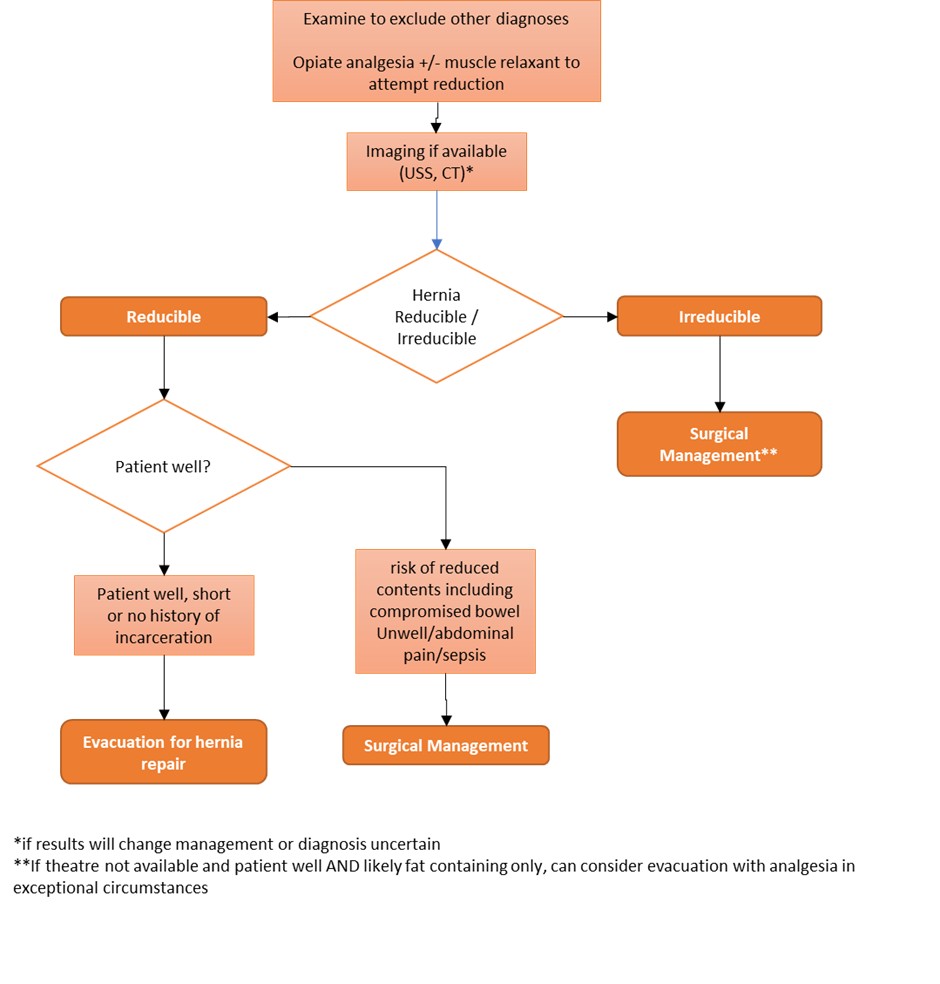
Advanced Assessment & Management
If mesh is available and sterility can be maintained then this should be used.
If mesh is not available then a Shouldice repair for inguinal hernia has been shown to be the strongest repair.
In a deployed non-sterile setting, antibiotics should be considered, taking resource allocation into account.
Regional anaesthesia or perioperative field blocks are recommended to aid with analgesia and recovery.
There is growing evidence that a laparoscopic repair is less likely to result in chronic groin/nerve pain in young patients and evacuation back to R4 could facilitate this option, improving long term outcomes and preserve deployable status for young soldiers.
Prolonged Casualty Care
Antibiotics are not routinely recommended in hernia repair but should be considered in deployed surgical settings due to high risk environment.
Consider hernia repair for stable reducible hernia if this could return patient to their primary role earlier than awaiting delayed evacuation, if resources permit.
Paediatric Considerations
Inguinal hernia repair in children is usually via herniotomy without herniorrhaphy/hernioplasty and clinician experience (surgeons, anaesthetics and post-operative care) should be considered when undertaking paediatric surgery for hernia.