
Communication in Damage Control Resuscitation and Damage Control Surgery
Objectives
- To outline the recommended framework for communication during deployed DCR-DCS episodes.
- To reduce the cognitive burden on deployed clinicians through the employment of this framework for briefings and trauma team updates, thus enabling greater focus on clinical tasks.
- To provide a format where information can be shared and extracted, to support wider Command and logistical considerations.
Scope
This guideline applies to communication during the management of complex injured patients in the Role 2 and Role 3 deployed environments. Preoperative components are centred on the initial reception of casualties to a surgical facility. Other aspects of the preparation for and management of casualties are not covered.
Audience
All clinicians within the deployed setting delivering trauma care at Role 2 and Role 3.
Initial Assessment & Management
Basic Communication Tools during DCR/DCS
ATMIST:
Age
Time since injury
Mechanism
Injuries
Symptoms and Signs
Treatment Given
TSTACKP
Time from knife to skin (KTS)
Systolic blood pressure
Temperature
Acidosis
Clotting (ROTEM result if available), blood products transfused
Kit available/ unavailable, limits of surgery, consideration of futility
Plan and Progress
Key Communication Points in DCR/DCS
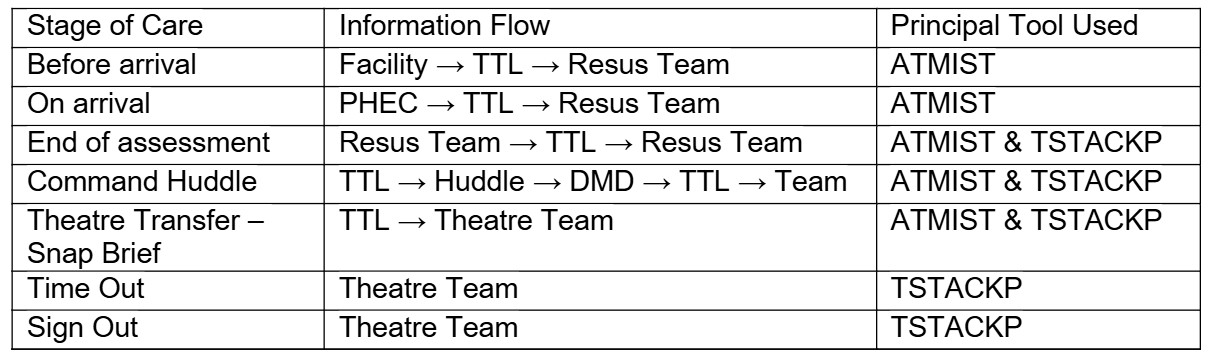
The identification and management of haemorrhagic shock is one of the principal challenges in DCR-DCS. The use of ambiguous terminology, especially the term “stable” should be avoided.
Haemodynamic status can be described well with these terms:
- Shock state:
- Overt shock – patients with low blood pressure
- Occult shock – patients with evidence of shock but preserved blood pressure. Tachycardia, narrowed pulse pressure, raised lactate.
- Isolated findings – e.g. modest tachycardia
- Normal haemodynamics
- Treatment response:
- Non-responder – minimal response to fluid therapy
- Transient response – a short-liver response to fluid therapy
- Transfusion dependent – response is maintained by ongoing resuscitation. This is a form of transient response
- Sustained response – response to treatment that is maintained without significant further transfusion.
Initial Assessment & Management
Before arrival (links to existing Role 2/3 preparation for casualty receiving team)
The aim of the initial brief is to establish a shared mental model within the team of the expected situation and how the team will respond, including individual roles.
Led by the TTL:
- Introductions
- What we know
- ATMIST
- Tactical context (including operational tempo, facility status, evacuation considerations and implications for futility thresholds)
- Equipment status
- Blood product status
- What we expect
- What might change
- Assign specific roles
- Suggestions/ concerns
On Arrival of Casualty
- Immediate life-saving interventions.
- ATMIST handover from transferring clinician.
- Primary survey.
- Initial interventions.
- Surgical assessment if required.
- Secondary survey if appropriate
- Re-establish shared mental model:
- TTL-led
- All involved
- Futility considered
- Plan proposed
- ATMIST and TSTACKP readied
Command Huddle
The Command Huddle allows decisions about patient disposal to be made in a coordinated way in the light of the needs of others and the disposition of the facility.
Members:
- Trauma Team Leader (TTL) – usually EM Consultant
- Consultant General/ Vascular Surgeon
- Consultant Orthopaedic Surgeon
- Consultant Anaesthetists
- Deployed Medical Director/ Clinical Lead
Where there are multiple casualties, the DMD or clinician overseeing the incident response should determine what representation is needed for each patient while ensuring adequate specialty participation.
The Command Huddle should consider:
- ATMIST and TSTACKP for each patient being considered
- Status of other patients
- Capacity of departments
- Blood products and other resources
- Tactical considerations:
- Anticipated and potential casualties
- Evacuation options
- Fixation of facility by embarking on surgery
The Command Huddle will then determine disposal:
- Surgery
- Imaging
- Non-operative management, serial observation [see SNOM CGO]
- REBOA if surgery delayed [see REBOA CGO]
- Ward – level 1, 2 or 3
- Transfer
- If futile, withdrawal in most appropriate location.
Communicate decisions to all affected teams
Snap Brief – On Transfer to Theatre
In an MTF, the TTL will usually oversee the transfer to theatre and participate in the Snap Brief. If this is not the case, there must be a clear and formal handover of the patient to the anaesthetic team before transfer.
Condensed pre-operative checklist based on WHO checklist, focused on physiological and surgical considerations:
- Surgeon
- Confirms correct patient and ID
- Clinical & radiological findings& imaging
- Suspected injuries
- Surgical plan
- Anaesthetist
- Systolic blood pressure
- Temperature
- Acidosis
- Clotting (ROTEM result if available), blood products transfused
- Kit available/ unavailable, limits of surgery, consideration of futility
- Plan and progress
- Antibiotics and TXA given
- Blood products available
- Major safety issues discussed
- Start time recorded
Sit Reps
Sit Reps should occur every 10 minutes during the early and most active parts of DCS.
Sit Reps should usually be anaesthetist lead using TSTACKP model.
Additional Sit Reps may be required:
- Before or after critical manoeuvres, such as opening a cavity, (un)packing, (un)clamping, release of tourniquets etc.
- In the event of an unexpected intra-operative crisis – please see Crisis Containment Model in Accordion Content
Surgeon and anaesthetist may decide to reduce the frequency of Sit Reps once the physiology, bleeding and contamination are brought under control.
Communication of Crucial Intraoperative Events
Outside of a Sit Rep, there may be physiological or anatomical events that need to be communicated to team members at a time when individuals have limited bandwidth. The information holder should follow the following cycle:
- Name audience for the information
- Check audience is attending
- Convey information
- Check understanding
Usually, such information will be best communicated to all. The secondary surgeon/anaesthetist etc will be an important adjunct to communication with the primary.
Sign Out and De-brief – on completion of surgery
1. Team sign-off at completion of surgery to deliver whole-team update of interventions and postoperative care plan.
- Surgeon
- Injuries identified and physiology
- Surgical findings and interventions
- What has been treated, temporised or left untreated
- Ongoing plan - need for return to theatre, if so timeline
- Number of packs retained
- Anaesthetist
- TSTACKP
- Plan for ongoing treatments and support
- Both
- Plan for antibiotics, VTE prophylaxis, nutrition, other interventions/ therapies
- Hold or evacuate patient
2. Team de-brief immediately following sign-out, using STOP (or similar framework):
- Summarise
- Things that went well
- Opportunities to improve
- Points to action and responsibilities
3. Plan for resetting and restocking of facility
Documentation after surgery
Operation notes should contain the following information:
- Patient demographics
- Responsible consultants
- Anaesthetists and operating surgeons
- Indication(s)
- Operation(s) performed
- Separately documented operations performed on the patient during the same theatre session should be acknowledged.
- Incision(s)
- Findings
- Procedure
- Closure
- Post-op instructions. Recommended format: OIL PIT TINDR (WARS)
OIL – items required in the post-op period
- Observations
- Investigations
- Laboratory Tests
PIT – items to be prescribed
- Pain relief
- Infection Prophylaxis and Treatment
- Thromboprophylaxis
TINDR – Plans for post-op care +/- re-operation
- Tubes
- Incision
- Nutrition
- Disposal
- Retained Swabs
WARS – For extremity, spine and pelvis cases. Mobilisation guidance should be substituted in other cases.
- Weight Bearing
- Activity Level
- Range of motion
- Splintage
Prolonged Casualty Care
This framework can be applied to both receiving casualties having undergone prolonged casualty care, and where there may be a prolonged hold at the Role 2/3 facility once DCR-DCS has been performed. Additional considerations for the care of these patients should be highlighted at the ‘Command Huddle’ and/or the ‘Sign out’, as appropriate.
Paediatric Considerations
This framework can be applied to the care of paediatric patients.