
Clamshell thoracotomy
Objectives
1. Present indications for clamshell thoracotomy
2. Present the important procedural details for clamshell thoracotomy
Scope
This guideline highlights the patients who may benefit from clamshell thoracotomy, and how the procedure should be undertaken, and when.
Audience
All clinicians who are involved in the emergency resuscitation of patients following thoracic trauma (blunt or penetrating).
In particular, this guideline is relevant to the General & Vascular Surgeon, Emergency Medicine physician, Emergency Department Nursing team, Perioperative Practitioners, and the Anaesthetic and Intensive Care Unit teams.
Initial Assessment & Management
Indications for clamshell thoracotomy:
- Access to the chest for traumatic cardiac arrest with intra-thoracic injury and hypovolaemia to gain access to the injury within the chest.
- Large volume initial haemothorax in intercostal drain insertion(>1500ml) and/or prolonged bleeding (>200ml/ hour for 2 hours) with cardiovascular compromise.
- Pericardial tamponade
- Cardiac injury
- Bronchopleural fistula and failure to ventilate and oxygenate
- Mediastinal penetrating injury with risk of oesophageal injury
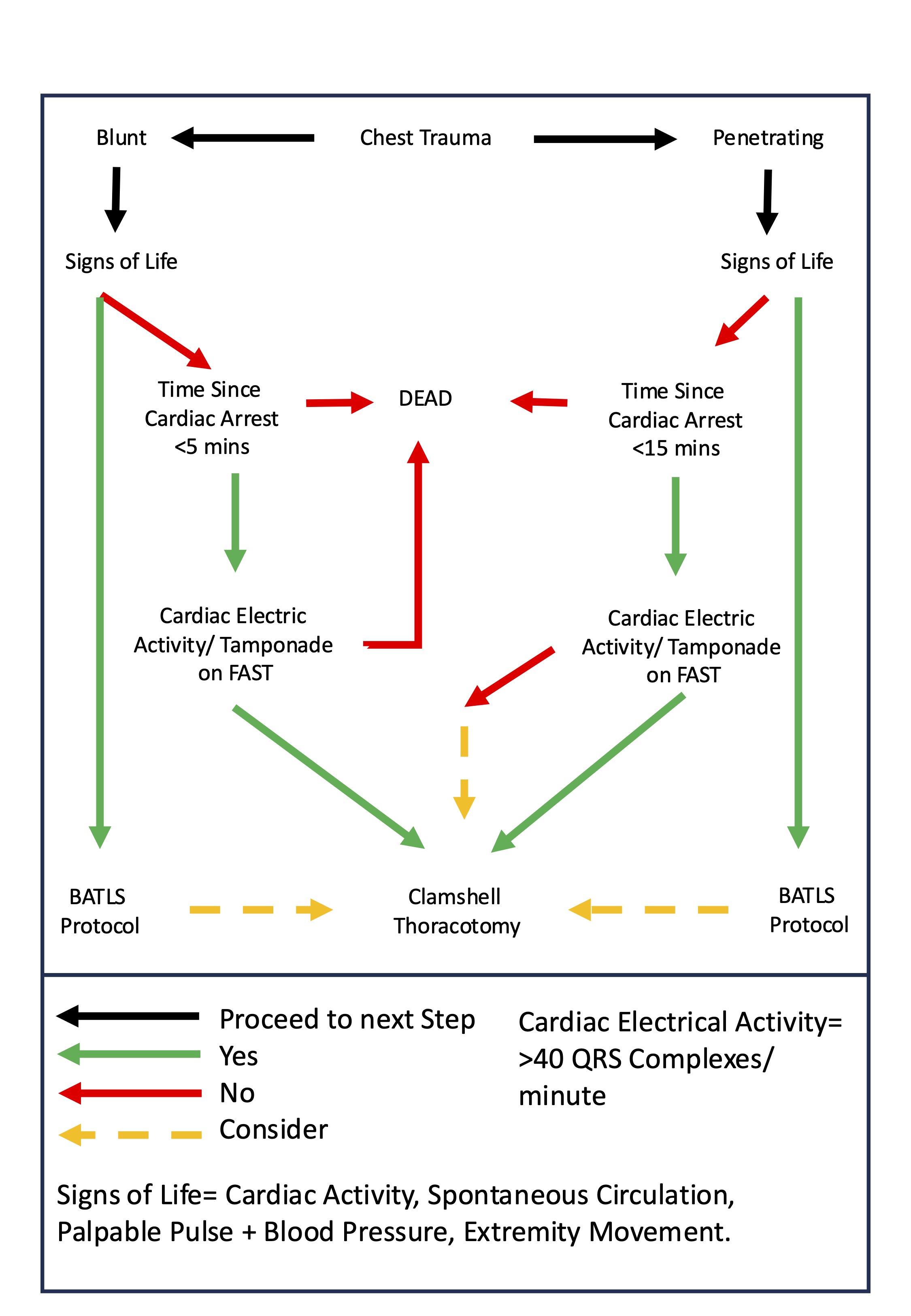
Position and Procedure
Position should be supine with arms abducted on arm boards in crucifix position if possible, or arms abducted to open rib space.
- Enter the thorax with a left thoracotomy, which should be extended to a clamshell incision.
- Open the pericardium with an inverted T incision to remove tamponade and evaluate cardiac injury taking care not to damage the phrenic nerve.
- Repair cardiac injuries with staples, horizontal mattress 2/0 or 3/0 prolene sutures taking care not to occlude the coronary vessels. An inflated foley catheter can also control haemorrhage.
- Haemorrhagic control can be achieved with aortic occlusion by either digital pressure or aortic cross clamp which allows space for internal cardiac massage.
The inferior pulmonary ligament can be divided and moved anteriorly to allow access to the descending aorta. The internal thoracic arteries should be identified and suture ligated to prevent bleeding upon return of circulation.
Chest closure
- Washout the thoracic cavities and place apical and basal drains bilaterally
- Pericardial drain if required
- Ethibond sutures placed from lateral to medial bilaterally and secure with a surgeon's knot
- 2-0 Vicryl suture for fascia and staples to skin
Advanced Assessment & Management
Resource considerations
The decision to proceed to clamshell thoracotomy should be taken in context with the ongoing operational environment. RT should be performed in a medical treatment facility (MTF) with the correct expertise, intensive care unit/anaesthetic support, and the correct equipment.
Prehospital clamshell thoracotomy is extremely complex in austere environments and is not recommended as an intervention. Similarly, it is not recommend during a mass casualty event where it would negatively impact on other patients with a better chance of survival.
Clamshell thoracotomy is likely to render the facility deficient in consumables and kit until resupply is established. Survivors require huge volumes of blood products and fluid. The emergency donor panel may need to be activated for additional blood. The surgical facility may be unable to receive further casualties until resupply which will be required immediately following a surgery to ensure operational capacity. Following clamshell thoracotomy a patient will be left requiring intensive care unit support, require definitive surgery and onward MEDEVAC.
Kit and consumables
Full personal protective equipment is required to protect the clinician while performing the procedure from infectious and sharps injuries. A scalpel, aortic clamp, 2x finochietto retractor, foley catheter, scissors and sutures are required which can be found in the following modules will be required 316, 317-1, 317-2, 317-3, 535, 567 and potentially a 507. These modules are designed to treat a total of 8 casualties before resupply.