
Newborn Life Support
Warning
Objectives
To outline the management of resuscitation in the newborn infant (in the first 24 hours of life).
Scope
This guideline describes the resuscitation of neonates (newborn infants) on operations. There is a separate guideline for managing cardiopulmonary arrest in older infants and children (Paediatric Life Support).
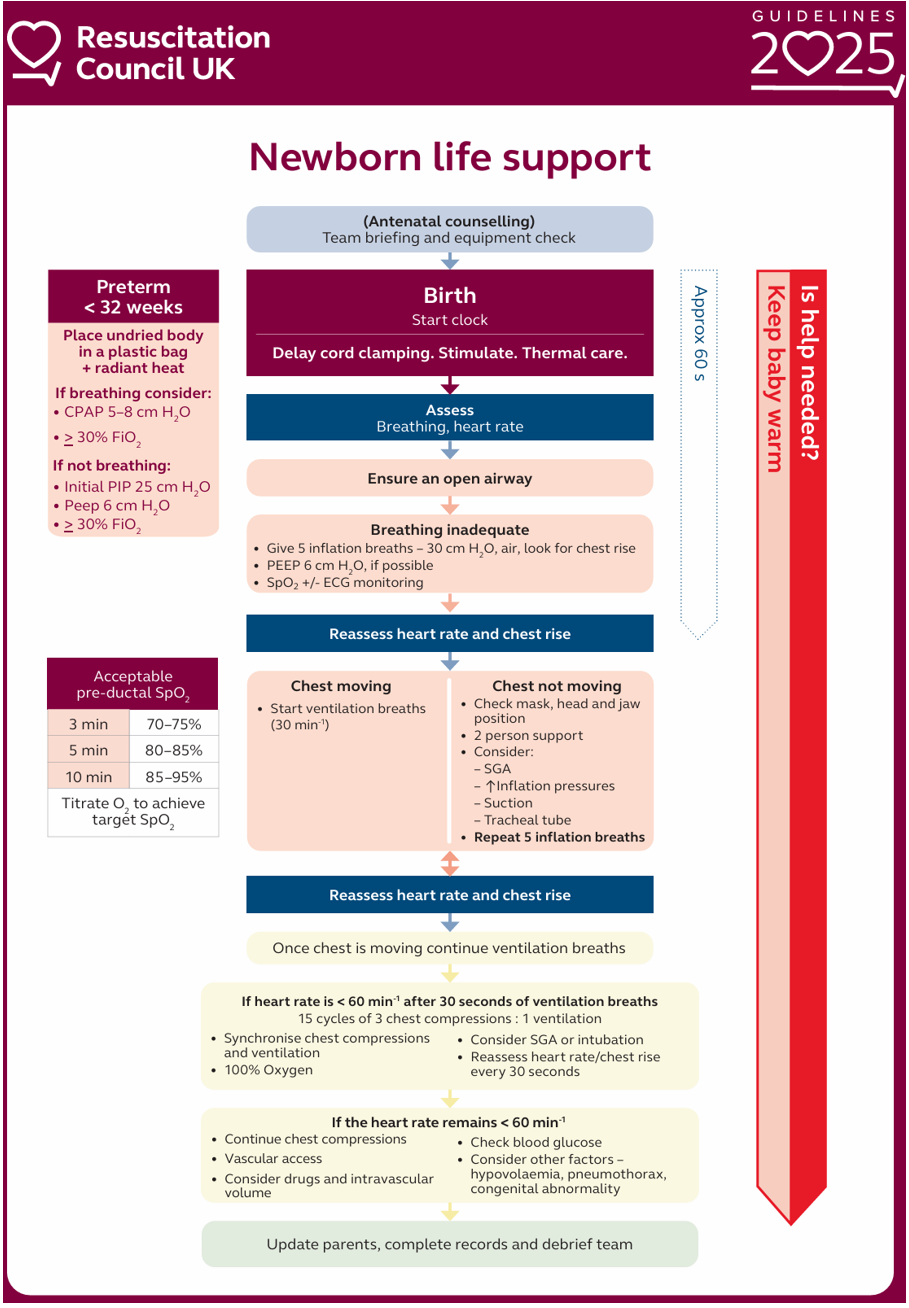
The Newborn Life Algorithm is at the bottom of this guideline
Audience
This guideline is intended for the use of registered healthcare professionals fulfilling a general role in a forward medical location or in an Emergency Department on deployed operations.
Initial Assessment & Management
Most newborn babies will not need help with the transition to breathing air and will only require proactive thermal care. Where neonatal distress is present following birth, clinicians should manage babies in accordance with the Resuscitation Councils Newborn Life Support Guidelines - algorithm is available within this guideline.
There is paucity of data available for resuscitation of extremely premature infants (<25 weeks) in the UK.
Initial assessment and management
It is useful to designate 2 teams (if resources allow) – one for mother and one for baby.
Preparation prior to birth (where possible)
Equipment/environment:
- Clean, flat surface – off the floor
- Hat (any), dry towels/cloths
- Suction
- Self-inflating bag (preferably paediatric sized and smallest face mask available)
- Clock/watch with seconds
- Sterile scissors/clamp for cord
- PPE
- Radiant heat source – delivery area should be approx. 24oC.
- Stethoscope
- Monitoring equipment (sats, HR, temp)
- Paediatric airway equipment (if available)
- IO access
- A clear plastic bag for preterm babies (sandwich bag is fine)
At birth
- Immediately after birth start a timer
- Assess the infant for signs of distress
- If making respiratory effort, consider delayed cord clamping (> 60s) to allow autotransfusion of cord blood back to neonate.
- If the infant is floppy, making no respiratory effort or any other concerns then clamp and cut the cord, leaving approx. 5cm of cord attached to baby.
- Dry and stimulate the infant using clean, dry towels. Cover the head with a hat and the body with dry towels to prevent heat loss.
- Assess:
- Breathing
- Heart rate (HR) – using stethoscope
- Tone
- Keep baby warm and continue to stimulate during delayed cord clamping and assessment.
- If the infant is breathing regularly, HR >100 bpm, normal tone then they can be given to parents for consideration of skin to skin. Reassess every 30-60s.
- If the infant is floppy, HR <100bpm, not breathing regularly then continue below:
Airway and Breathing
- Open the neonate's airway maintaining a neutral position.
- A small rolled-up towel (approx. 2cm thick) positioned under the shoulders can help with this positioning.
- If infant is gasping/not breathing, administer 5 inflation breaths over 2-3s each, using air only. Purpose is to clear amniotic fluid from lungs
- If pressure ventilation is available, then set this for 30cm H2O and PEEP 5-6cm H2O.
- The chest may not rise for the first few breaths – continue to deliver 5 breaths then reassess.
- Consider attaching a sats probe to the right hand and ECG monitoring if available.
- Reassess Heart Rate and chest movement:
- An increase in HR within 30s of ventilation, or a stable HR >100 bpm, usually confirms adequate ventilation.
- HR <100 bpm or decreasing usually suggests continued hypoxia.
- Chest moving:
- Start ventilation breaths at 30/min
- Assess HR and chest rise every 30s
- Chest not moving:
- Check airway positioning – consider 2 person technique
- Consider suction/airway adjuncts – repeat 5 inflation breaths
- Assess HR and chest rise every 30s
Heart Rate and Chest rise
Continue positive pressure ventilation until the infant is breathing adequately and the HR is >100bpm.
If there is no HR response:
Confirm optimal airway positioning and need for adjuncts/intubation
If HR <60bpm after 30s ventilation breaths, start chest compressions:
3 compressions: 1 ventilation
100% Oxygen
Reassess every 30 seconds
If heart rate remains <60bpm or undetectable then consider IV/IO access and drugs can be considered
Continue compressions and ventilation until the newborn recovers or the decision is made to stop the resuscitation effort
Possible causes to consider:
- Hypoglycaemia
- Glucose – 2ml/kg 10% glucose +/- IV infusion
- Hypovolaemia
- Pneumothorax
- Congenital/cardiac abnormality
Neonatal resuscitation in the deployed environment is likely to be limited by the lack of neonatal intensive care support available.
Neonates requiring extensive ventilatory and circulatory support are unlikely to survive in the deployed setting.
If available, early repatriation to a local healthcare facility may help improve the outcome for a collapsed neonate however, in the event of a prolonged hold then evacuation to other R2/3 facilities is unlikely to change the outcome.
Pragmatic decision making should be supported, with involvement of the parents where possible to ensure full understanding of the situation.
In the event that resuscitation efforts have not been successful, the baby’s body should be treated with care and should follow the deployed management of the dead. It is possible that parents will wish to hold the infant prior to this process and efforts should be made to facilitate this.