
Globe Injury
Warning
Objectives
To guide management of patients presenting with globe injury.
Scope
This guideline covers the initial assessment and management of a patient with globe injury. It does not necessary cover the specific treatment for each individual cause.
Audience
This guideline is intended for the use of registered healthcare professionals fulfilling a general role in a forward medical location or in an Emergency Department on deployed operations.
Definitions
- Closed globe injury occurs when there is no full thickness injury:
- Contusion – no full thickness injury, generally a blunt injury.
- Lamellar laceration- involving partial thickness injury of the eye wall with a sharp object.
- Open globe injury involves full thickness injury:
- Rupture - Blunt object causing full-thickness injury of the eye wall.
- Laceration - Sharp object causing full thickness injury to the eyewall. This can be further divided into:
- Penetrating injury - single entry wound with no exit wound.
- Intra-ocular foreign body - entrance wound with retained foreign body.
- Perforating injury - two full thickness wounds, entrance and exit wound.
Suspected globe injuries require prompt assessment as they are potentially eyesight threatening events. Intra cranial and extra ocular trauma should also be considered. Penetrating injuries are not always visible and may rely on history alone. In blunt injury the globe is compressed antero-posteriorly and stretched equatorially.
Initial Assessment & Management
History
Take details of the injury
- Consider blunt vs penetrating globe injury.
- Object size / shape / velocity
- Is there the possibility of an intraocular foreign body from the mechanism
- Was personal protective equipment (PPE) being used?
Eye injuries can be distracting: check for any concurrent non-ocular injuries (especially head and cervical spine).
Specifically ask about pain, pain on eye movements, any subjective change in visual acuity or any visual disturbance, photophobia, diplopia, redness / swelling, and any sensation of a foreign body in the eye.
Examination
Remember ABCDEFG for eye injury examinations:
- Acuity - ideally use a well-lit Snellen chart or a phone app if available; check both with correction if required and with a pinhole
- Bright light examination - check pupils and RAPD
- Cornea and Conjunctiva - with fluorescein and topical anaesthesia if available; note if anaesthetic drops relieve discomfort
- Disc exam - direct fundoscopy
- Eye movements
- Fields
- Go to the other eye - always examine both
Use a systematic approach to thoroughly assess the injured eye
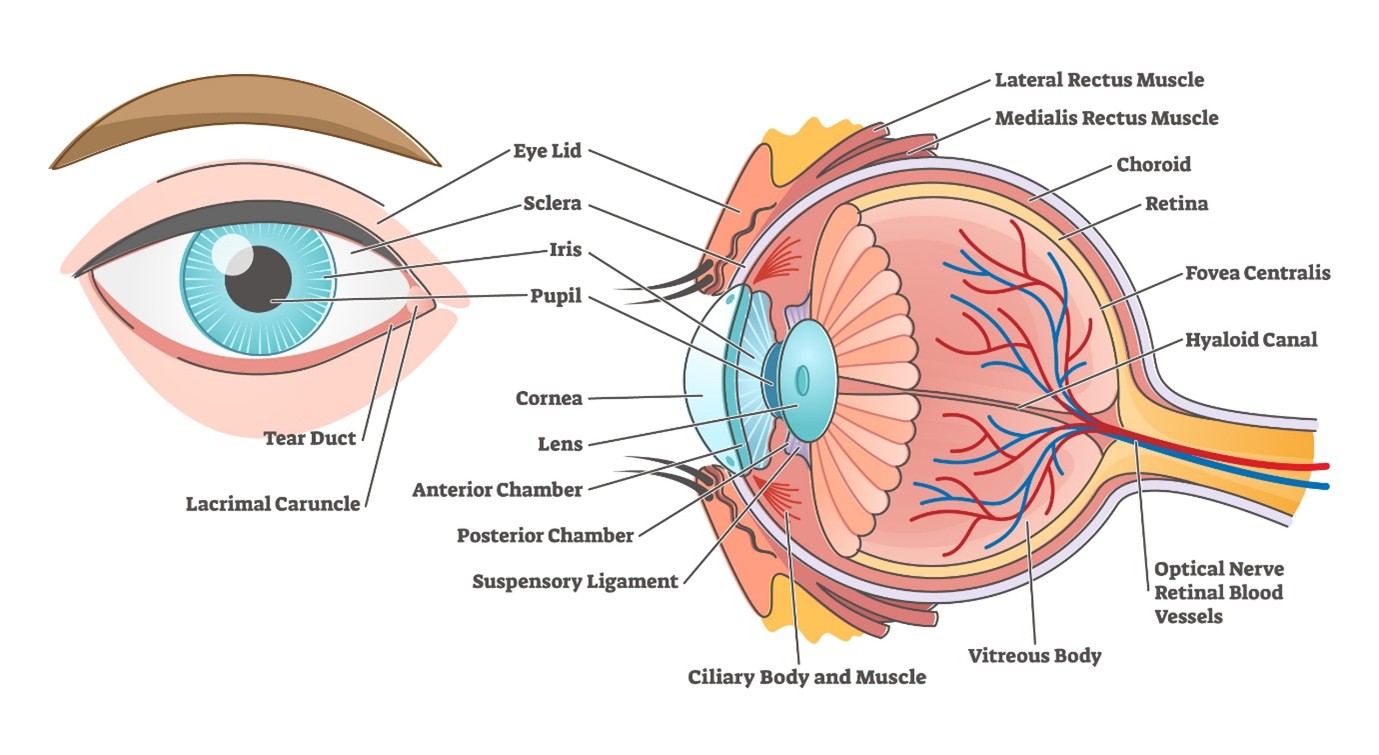
Check the globe – is it misshapen or collapsed? Look for any obvious protrusion of tissue, including aqueous leaks, prolapsed uveal tissue or vitreous fluid that may indicate that the globe is punctured or ruptured. Look for foreign bodies.
Examine the orbit - check for bony tenderness and/or deformity that may be evidence of fracture; assess eye movements to identify muscle entrapment, compare the eyes for enophthalmos (posterior displacement of the eyeball)
Check upper and lower lids – look for lacerations and palpate gently for subcutaneous emphysema which is highly likely to indicate an orbital fracture
Examine the conjunctiva - 360 degree appearance of subconjunctival haemorrhage may indicate globe rupture.
Examine the cornea / sclera for any evidence of abrasion / laceration, using fluorescein dye. Check for foreign bodies and corneal oedema. Leaking fluid from a laceration will give a bright green "waterfall effect" under cobalt blue light (Seidel test), but remember that a penetrating eye injury may not be visible and may rely on history alone.
Look at the anterior chamber for hyphaema.
Compare both pupils – look for distorted/irregular shape, holes in the iris, poor reactivity, and for a relative afferent pupillary defect (RAPD ) using the swinging torch test, and look at the lens for a traumatic cataract or dislocation.
Undertake fundoscopy to examine the retina looking for a reduced red light reflex which may indicate vitreous haemorrhage or traumatic retinal detachment
Remember that blunt trauma can precipitate orbital compartment syndrome - see CGO for details.
Take care not to overlook potential non-orbital injuries including head injuries and cervical spine injuries when assessing patients who have sustained an eye injury.
Treatment
Aim to shield and ship casualties with suspected or confirmed globe injury if the tactical situation permits.
"Shield and ship" refers to protecting the eye while evacuating the patient to a higher level of medical care at the earliest safe opportunity. Place an eye shield if available, or otherwise an improvised rigid covering over the affected eye. Do not pad.
- Prevent further damage.
- Protect injured eyes (known or potential injuries) with a rigid eye shield or an improvised substitute.
- Maintain patient comfort, providing pain control and prophylactic anti-emesis. Do not use topical anaesthesia for analgesia. Topical anaesthetic is to be used as an aid to examination ONLY
- DO NOT put pressure on eye with suspected open globe injury. DO NOT pad the eye.
- Prevent Valsalva which can increase the risk of extrusion of intraocular contents. Use anti-emetics to treat nausea and vomiting aggressively.
- Give antibiotic cover as per DMS antimicrobial guidance:
- administer CIPROFLOXACIN 500mg BD PO (if tolerated) or 400mg IV BD.
- alternatives include Levofloxacin 750mg PO/IV QDS or Moxifloxacin 400mg IV QDS
- if supply allows additional gram-positive cover may be given - CEFTRIAXONE 1g IM STAT (single dose) or CEFUROXIME 500mg BD PO.
- Avoid strenuous movements; bed rest with head elevated 30 degrees if possible.
- Give tetanus prophylaxis if not immunised, or if the eye is heavily contaminated with material likely to contain tetanus spores - follow the CGO for tetanus prone wounds (link to follow).
- Do not remove foreign bodies if an open injury is suspected or confirmed. Large embedded foreign bodies should be bolstered for support.
- Consider padding/covering uninjured eye to reduce movement of the injured eye
Reach back to ophthalmology for advice at the earliest opportunity.
If possible, evacuate all vision-threatening injuries so that they can receive treatment by an eye surgeon within 24 hours.
Note that ultrasound may be useful to examine for retinal detachment, lens abnormalities and suspected foreign bodies, but its use is contraindicated in confirmed or suspected open globe injuries.
DO NO HARM - Top Ten things to avoid in suspected globe injury
-
DO NOT let a suspected eye injury leave your level of care without rigid eye protection.
-
DO NOT patch. It puts pressure on eye. (DO shield but DO NOT patch.)
-
DO NOT wrap. It puts pressure on eye.
-
DO NOT place anything under an eye shield, including gauze (except in confirmed isolated lid injury with no open globe injury)
-
DO NOT put pressure on eye with suspected open globe injury; it may increase the risk of extrusion of intraocular contents.
-
DO NOT check intraocular pressure - an ophthalmic surgeon will check.
-
DO NOT attempt ultrasound of the eye. It places pressure on the eye.
-
DO NOT remove impaled or resistant foreign bodies.
-
DO NOT attempt to repair the eye.
-
DO NOT enucleate or eviscerate or debride tissue, even if eye is severely traumatised.
Advanced Assessment & Management
In general, the guidance provided for forward medical locations will continue to apply.
CT imaging may be useful, especially if oedema prevents adequate examination, and may allow identification of optic nerve injuries or orbital fractures as well as visualisation of intraocular foreign bodies. If possible, specify fine cuts through the orbit to include mid-face and skull base. If this is not done, small foreign bodies can easily be missed.
MRI is unlikely to be available in the deployed environment but is also contraindicated if there is any possibility that the eye injury involves a metallic foreign bodies.
Depending on local arrangements ophthalmology advice or consultation should be rapidly sought. If unavailable locally then evacuation to an ophthalmologist should be obtained using the shield and ship principles. Open globe injuries require closure by an ophthalmic surgeon within 24 hours to reduce significant visual morbidity.
Prolonged Casualty Care
If prompt evacuation is not possible, continue antibiotic regime and maintain good analgesia and anti-emesis.
Record visual acuity daily but avoid touching the eye. Keep area under shield as clean as possible without touching the lids/eye. If eye contents prolapse onto lids/face, do not touch them.
If you note any changes in appearance, seek reach back to discuss with an ophthalmologist if possible.