
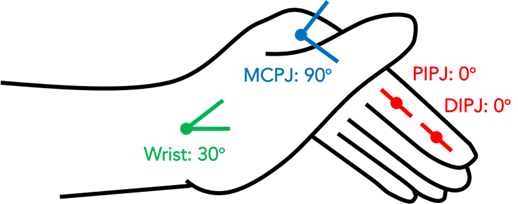
Wrist extended to approximately 30°
MCPJ flexed at approximately 90°
Fingers straight - PIPJ and DIPJ both at 0°
Update Jul 2026
New guidelines continue to be added.
The content will undergo continuous review by all our cadres.
Do use the search function on the app and website to make it easier to find relevant guidance.
Feedback on layout can be given below.
Saf
[Updated 1 Jul 2026]
This guideline covers the management of hand injuries: their clinical diagnosis, immediate management, and considerations for onward evacuation to a higher level of care.
This guideline relates to the emergency management of both closed and open hand injuries. Note that there is a separate Ligament and Tendon Injuries CGO that provides advice on the care of closed tendon and ligament hand injuries. Tendon and ligament hand injuries that are related to open wounds should be evacuated to a deployed hospital facility and treated according to the Wound Excision CGO.
This guideline is intended for the use of registered healthcare professionals fulfilling a general role in a forward medical locations or in an Emergency Department on deployed operations. This guideline does not intend to advise on the specialist surgical repair of hand injuries.
Blunt and penetrating hand injuries are common on military operations. Common mechanisms involve; machinery, tools, gunshots, crushing forces, fragmentation weapons. The hand is anatomically intricate. Injuries can result in considerable and long-term functional deficits. Effective management may restore function and enable a service person to promptly return to full duties.
General Initial Management Principles
Open Hand Injuries
Remove gross contaminants (grass, soil etc). All wounds should be irrigated with copious (at least 1L) saline where resources allow. Large volume potable water is preferable to low volume saline and is an acceptable alternative. Antibiotics are recommended for open lacerations with structural damage or contamination. Clean wounds without structural damage can normally be closed primarily and managed in a forward location, with removal of sutures in 10-14 days. Wounds that have been irrigated can be tacked closed prior to referral. Do not close bites or grossly contaminated wounds.
Amputations
Patients who have sustained digital amputations should be evacuated to a facility with a hand surgeon if possible. The amputated digit may be salvageable. It should be wrapped in moist gauze swabs, sealed in a small bag, which is placed in a larger bag that contains water and ice: do not put the digit directly on ice. The patient should be given IV antibiotics in line with the management of open fractures. Isolated finger tip amputations can generally be managed conservatively, without referral to a surgeon, providing no more than 1cm2 of tissue is lost and that there is no exposed or injured bone. Non adherent dressings can be used to until the wound heals by secondary intention.
Extensor Tendon Injuries
Wounds to the dorsum of the hand may involve the extensor tendons which are relatively superficial. Visualisation of the tendon gliding throughout its range of movement is the way to exclude injury to it. Referral to a hand surgeon is indicated if division, complete or incomplete, of an extensor tendon is suspected. Surgical repair is usually indicated if there is a greater than 50% division of an extensor tendon. Divisions of less than 50% are typically managed conservatively with protected active mobilisation protocols.
Fight Bite
Suspect a ‘fight bite’ if a patient has wounds over the dorsal aspect of the MCPJ. This is when a fist and tooth have collided. These injuries carry significant risk for septic arthritis of the MCPJ: wounds should be assumed to be infected and managed with irrigation and antibiotics. Assess carefully for associated fractures and extensor tendon injuries.
Flexor Tendon Injuries
Palmar wounds may divide flexor tendons or digital nerves. If injury to these structures is suspected, then evacuate for surgical management.
High Pressure Injection Injury
Injuries from high pressure grease, paint and hydraulic systems can result in severe injuries that are often initially underestimated due the skin wound being potentially small. Although X-ray imaging may demonstrate the injected material, the extent of tissue damage cannot be seen: elevate the limb and evacuate for urgent surgical decompression and fasciotomy.
Nail Bed Injury
Crush injuries to the fingertip risk nailbed injury and underlying fracture. They should be irrigated and given antibiotic prophylaxis if fracture is suspected. If the nail remains adherent to the nail bed, leave it in position. A nail that has come off can be cleaned and placed back in position to cover and protect an injured nail bed. Damaged, adherent, nail may subsequently fall off after nail growth. If a wound involves the nail bed itself, it will require careful repair with fine absorbable sutures (for example 4/0, 5/0 or even 6/0 vicryl rapide) to prevent nail bed deformity - evacuate if necessary to allow this.
Nerve Injury
Hand sensation is functionally important. Patients suspected to have a divided nerve require evacuation to a facility where specialist hand surgery is available.
Subungual Haematoma
Blood can accumulate under a nail after a crush injury. The pressure can result in considerable pain. The blood can be released, and pain improved, by trephining the nail. Specialist trephining devices may be available, but otherwise an 18G needle can be used to drill through the nail and release the haematoma. The hole should be sited over the distal aspect of the haematoma (i.e. towards the finger tip). Relief should be immediate and in most circumstances the individual will be able to return to normal duties with a simple dressing applied unless there is evidence of other injuries.
Hand Fractures and Dislocations
Open fractures, fracture-dislocations, intra-articular fractures and large avulsion fractures, should be managed by a hand specialist if possible.
Open Fractures. Open hand injuries with underlying fractures are high risk for infection and should be irrigated with copious potable water, given antibiotics, splinted in POSI and evacuated for specialist review. Follow guidance in the open fracture CGO.
Metacarpal Fractures. Assess for angulation and rotational deformities through clinical examination and x-rays. If there is no marked angulation or rotational deformity, immobilise these fractures in a volar slab plaster in POSI for 4 weeks. Following immobilisation, the patient should undertake regular hand rehabilitation exercises. If there is marked angulation, shortening, rotational deformity, or an open fracture, the patient requires specialist review.
Proximal Phalangeal Fractures. Non-displaced closed fractures can be managed with elevation and buddy strapping. Some angulated closed fractures may be reduced after a local anaesthetic ring block, buddy strap and a volar slab plaster applied to maintain position for 4 weeks: seek specialist advice.
Proximal Inter-Phalangeal Joint (PIPJ) Dislocations. X-ray (if possible) prior to reduction. Rupture of the extensor apparatus or volar plate are common and may result in long term complications. Splint and arrange early follow up. Note the Volar Plate Injury section further in this guideline.
Middle Phalangeal Fractures. Non-displaced closed fractures can be managed with elevation and buddy strapping. Some angulated closed fractures may be reduced after a local anaesthetic ring block, buddy strap and a volar slab plaster applied to maintain position for 4 weeks: seek specialist advice.
Distal Inter-Phalangeal Joint (DIPJ) Dislocations. Note the Mallet Finger section further in this guideline. A simple DIPJ can be relocated and then splinted. Although imaging prior to relocation may be helpful to exclude an associated fracture, pre-reduction x-ray may not be feasible in a forward setting and attempting reduction without imaging is reasonable if there are no clinical features of an open or otherwise complex injury.
Distal Phalanx Fracture. Closed “tuft” fractures can be managed with splinting, analgesia and elevation, but more complex distal phalanx fractures may require surgical fixation - if in doubt seek specialist advice.
Soft Tissue Hand Injuries
Mallet Finger. A closed rupture to the extensor mechanism at the DIPJ resulting in an inability to fully extend the DIPJ. An x-ray should be undertaken to exclude an associated fracture. Unless there is a large avulsion fracture (>1/3 of the articular surface) that requires specialist management, the digit should be managed with a mallet splint and tape that strictly keeps the DIPJ fully extended continuously for 6 weeks.
Volar Plate Injury. This may result from hyperextension of the PIPJ and are characterised by joint swelling and volar plate tenderness. An x-ray should assess for an avulsion fracture. The joint should be buddy strapped and undergo early protected mobilisation.
Although it may be possible to manage minor hand injuries in a forward location, remember that even trivial injuries to the hand may impair an individual's ability to operate personal weapon systems and thus require evacuation from a forward location.
If evacuation is delayed, for a patient with a hand injury, continue to follow standard principles of management for any closed fractures / open fractures / wounds.
The immediate management of hand injuries in the paediatric population is the same as adults.
Wrist extended to approximately 30°
MCPJ flexed at approximately 90°
Fingers straight - PIPJ and DIPJ both at 0°