Objectives
To provide military clinicians on operations with information on how to conduct a mental health assessment including:
- General considerations
- Mental health history
- Mental state examination
- Risk assessment
- Actions following mental health assessment
- Other considerations
Scope
This guideline is for use with all personnel who may present as psychiatric casualties on military operations. Advice is designed to support non-specialists when a Forward Mental Health Team (FMHT) is not immediately available, with the primary purpose being to collect information to make initial decisions and allow onwards advice/support from mental health professionals at reach.
This guideline should be utilised in the context of the other psychiatric CGOs, which provide more detailed management advice for specific mental health situations: increased risk of suicide or self harm, alcohol/benzodiazepine withdrawal, acute stress reaction, and acute behavioural disturbance (including psychosis).
Audience
This guideline is intended for the use of registered healthcare professionals fulfilling a general role in forward medical locations or in an emergency department on deployed operations. These are not SOPs/ TTPs for deployed mental health clinicians and do not replace the need for deployed MH support.
Initial Assessment & Management
Immediate risk assessment and safety actions
All personnel have the potential to display behaviour out-of-character, act erratically, or place themselves or others at risk of harm. This potential is increased on operations and should particularly be considered in psychiatric patients/ those experiencing acute symptoms of mental ill-health. Assess risk to you, those around you, and the patient ensuring an environment which is calm and without easy access to potential weapons (i.e. sharps). Routine MTF sanitisation would usually include removal of a patient’s weapon system. This should be checked, and consideration given to other potential weapons and the need for search of the patient to ensure safety.
General Considerations
Presentation. Patients requiring mental health assessment can present via various routes and with a wide array/severity of symptoms. This is particularly true on operations, where the environment is likely to be unpredictable and carry inherent stressors. Patients may self-present or be encouraged to attend by CoC or peers. Symptoms may range from mild feelings of stress or unhappiness to frank psychosis (such as auditory hallucinations or paranoid delusions). On operations, where commanders will be continually considering mental health and fitness, early assessment, detection and treatment can mitigate risks (both to the patient, to others, and to the unit/operation), provide an opportunity for early support, and therefore ensure rapid return to meaningful function and active duties for the patient.
Consent and confidentiality. As with all patient interactions, informed consent should be sought wherever possible. The purpose and nature of the mental health assessment should be explained, as well as the limitations of confidentiality where risks are identified. It is also often useful to warn the patient that an assessment may take time and include questions about thoughts and feelings and past events which can feel challenging.
If severely unwell, such as lacking capacity or acutely disturbed in behaviour, then informed consent may not be possible. This scenario is further discussed within CGO: Assessment and management of acute behavioural disturbance (including psychosis).
Environment. Mental health assessments are best conducted in private areas with seating for both clinician and patient. On operations it is often necessary to be flexible and adaptable, with the main consideration an environment in which the patient is relaxed and able to freely engage. Considering safety, such as the removal of weapon systems and a chaperone or support close by, is essential.
Timing. A complete mental health assessment can take considerable time , with additional time to document the assessment fully. Clearly time may be limited on operations, and judgement is required to tailor the assessment. The presenting complaint, history of presenting complaint, mental state examination, and risk assessment should always be completed, but details of early life might be postponed to a later date.
The Mental Health Assessment
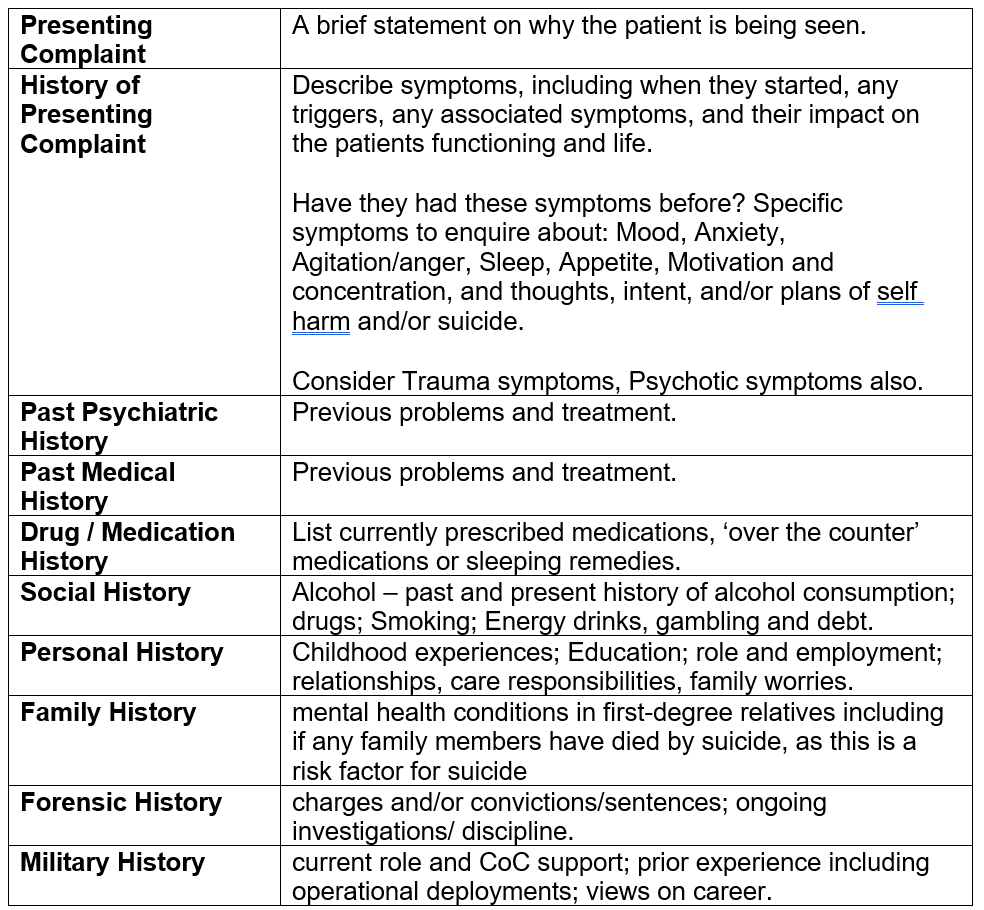
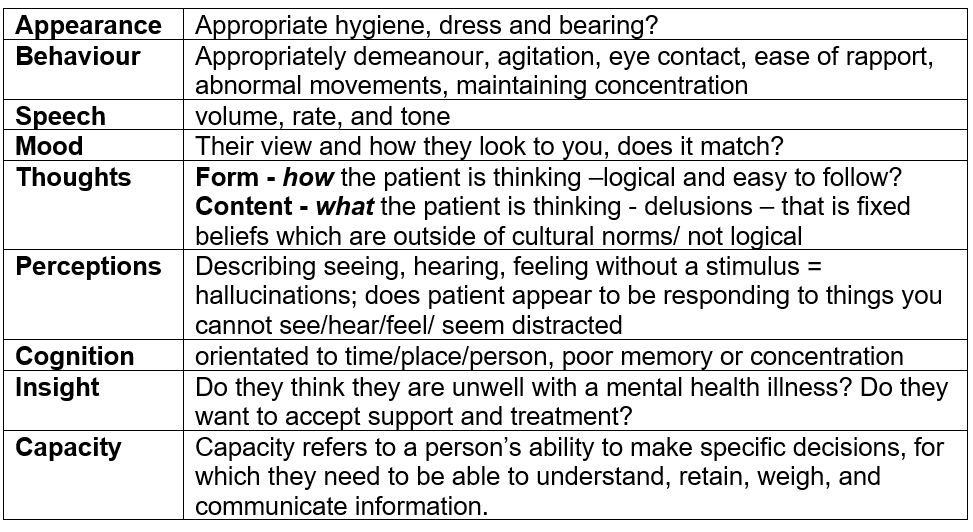
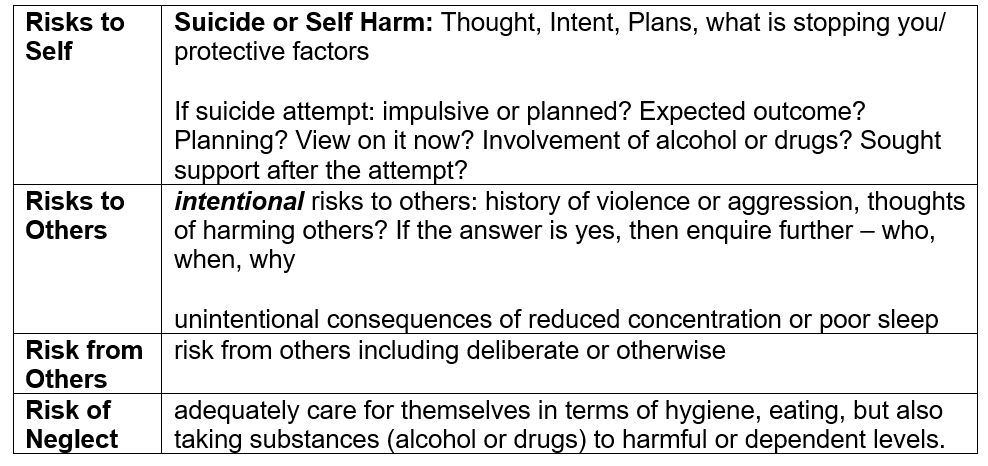
A mental health assessment is, at its core, a structured interview with a patient. The aim is to gather as much information as possible to generate a formulation which includes the working diagnosis and why the patient is presenting now, and then the creation of a treatment plan. The mental health assessment includes three components: history gathering (see Table 1 below), Mental State Examination (Table 2) and risk assessment (Table 3). A quick reference guide in accordion section below.
Table 1. Mental Health History
|
Presenting Complaint
|
A brief statement on why the patient is being seen.
i.e. Cpl Bloggs has self-presented after a 2 week history of increased anxiety.
|
|
History of Presenting Complaint
|
This should be the largest section of the assessment and be as detailed as possible.
A thorough description of all symptoms, including when they started, any triggers, any associated symptoms, and their impact on the patients functioning and life. Have they had these symptoms before?
Begin with open questions, recording the patient’s own words and phrases, and then move to closed questions to better understand all their symptoms and enquire about specific aspects.
Specific symptoms to enquire about include:
Mood (depressed and/or elated), does it vary during the day?
Anxiety, including any panic attacks
Agitation/anger
Sleep
Appetite
Motivation and concentration (for work, for exercise, for hobbies)
Enjoyment in activities
Thoughts, intent, and/or plans of self harm and/or suicide. Thoughts, intent, and/or plans of harm to others. These will form part of the risk assessment, which is discussed later in this guidance. However, every patient MUST be asked about thoughts of harm to self or others, and this is usually done as part of the detailed history of presenting complaint.
Trauma symptoms, which can include hypervigilance, increased startle response, and intrusive memories or flashbacks of the traumatic incident. Enquire about non-operational and pre-military trauma, as well as incidents during operations.
Psychosis symptoms, which can include delusional beliefs (beliefs which are fixed and not consistent with cultural norms, often paranoid and persecutory in nature), and hallucinations (hearing, seeing, or feeling things which others cannot).
|
|
Past Psychiatric History
|
Has the patient been diagnosed or treated previously for their mental health? Detail this in depth, including any talking therapies and/or medication received.
Remember to enquire about prior to their military service and during childhood.
|
|
Past Medical History
|
Enquire about their physical health, both present and past. Many physical health conditions influence mental health – and vice versa.
|
|
Drug / Medication History
|
List currently prescribed medications, and their doses.
Enquire about ‘over the counter’ medications, such as St John’s Wort, or sleeping remedies.
|
|
Social History
|
Alcohol – past and present history of alcohol consumption. Include alcohol units per week, and enquire about any concerning drinking habits – such as early morning drinking, or getting into trouble at work due to alcohol.
Recreational drugs – past and present, inc. prior to joining the military.
Smoking history – include vapes and any nicotine replacement.
Energy drinks – high in caffeine and increasingly used, enquire about consumption.
Gambling – enquire about any debt, and past and present gambling habits.
|
|
Personal History
|
This is an essential aspect of the mental health assessment, as it provides a rich source of information about who the patient is, how they have experienced the world, and their social environment.
Sometimes rapport needs to be developed prior to gathering all the information, and this section of the history is often added to over time. Provide as much detail as you have time for, and for which the patient is comfortable providing.
Enquire about:
Childhood. Were there any health concerns during their birth or early life? How would they describe their early life and the family home? Was there any neglect or abuse?
Education. How was primary and secondary school? Did they have friends? What qualifications did they gain?
Employment. Did they have a job prior to joining the military? Did they enjoy it?
Relationships. What is their sexual orientation? Describe major relationships past and present. Do they have children? What is their current living situation when not on operation? Are they worried about friends and/or family back home?
Premorbid personality. How would they describe their personality when well? How would others describe them?
|
|
Family History
|
This is specifically asking about mental health conditions which their first degree relatives have been diagnosed with – as many mental health diagnoses have a genetic component.
Enquire if any family members have died by suicide, as this is a risk factor for suicide in and of itself.
|
|
Forensic History
|
Have they ever been in trouble with the police? Include both civilian and military forces. Enquire about charges and/or convictions/sentences.
Also enquire about any ongoing investigations – which can often take many months or years to conclude.
|
|
Military History
|
An important aspect of mental history assessment, as this is often crucial to a patient’s presentation and recovery.
Enquire about their motivation to join the military, and then how they experienced Phase 1 and Phase 2 training. List their career (units, platforms, operational deployments and so forth), and specifically ask about any incidents/events that they have found traumatic.
How do they currently view their career, role, and unit/platform? Do they wish to remain in the military? What are their career aspirations?
|
Mental State Examination (MSE)
The MSE is an ordered documentation of the assessing clinicians’ observations about the patient’s behaviours and mental health symptoms at the time of the assessment. It provides a ‘snap shot’ of how the patient is, much like any physical examination, and thus comparisons of MSEs over time can be very helpful in diagnosis and treatment planning.
A comprehensive MSE provides evidence for (and against) mental disorders, including their severity. The MSE can also be completed purely observationally if the patient is unable to engage in a full history. Like the mental health history, a standard order is followed, which allows clinicians to quickly assimilate the information – this will be of significant benefit to any reach back mental health professional.
Of note, MSE can be unnecessarily technical, and has many psychopathology terms in the textbooks (illusion, neologism, alogia and so forth). These are not necessary to complete an excellent MSE: write down what you see and hear in normal language.
Table 2: Mental State Examination
|
Appearance
|
What is the patient wearing? Does it appear appropriate for the situation and environment?
Are they taking care of their personal hygiene? Are they adhering to military standards of dress and bearing?
|
|
Behaviour
|
Do they present appropriately in terms of demeanour and behaviours? Are they polite, respectful, acknowledge rank correctly? Conversely, are they aggressive, agitated, or rude?
What is their eye contact? Is rapport easy to establish? Do they have any abnormal movements, such as tics or unusual posture? Can they maintain concentration for the duration of the assessment?
|
|
Speech
|
What is the volume, rate, and tone of speech?
Is the speech flow easy to follow?
As examples, agitated patients might have a fast and loud speech, whilst depressed patients are more likely to have a slow and quiet speech.
|
|
Mood
|
Write verbatim what the patient says about their mood “I feel down all the time”, “I feel great, loads of energy”: this is their subjective mood.
Also record your objective assessment of their mood. Is it low/depressed, or appears elated?
Record any symptoms of anxiety, or where observed mood seems incongruent with the mental health history.
|
|
Thoughts
|
Observation and assessment of thoughts is split into two areas:
Thought form. This is how the patient is thinking – does it seem logical and easy to follow? Confused and/or psychotic patients often think (and therefore speak) in ways which are hard to follow. If you find yourself confused listening to them – this is likely a disorder of thought form.
Thought content. This is what the patient is thinking. Primarily here we are thinking of delusions – that is fixed beliefs which are outside of cultural norms and not felt to be true by the assessor. A classic delusion might be paranoid and persecutory “the military police are going to arrest me!” (of course this might be true – always check!). A lesser thought content abnormality is an overvalued idea “I think the military police might be looking for me, I’m not sure….”. These beliefs should be fully explored as part of the history of presenting complaint.
|
|
Perceptions
|
Our perceptions are what we see, hear, feel and experience.
Abnormal perceptions are usually hallucinations – where the patient sees, hears, or feels something without a stimulus.
In auditory hallucinations, often the patient will experience sounds first, which may progress to mumbling voices (which they cannot understand), before then voices which are clear and understandable. As with abnormal thoughts, enquire robustly about these symptoms as part of the mental health history.
For MSE, note here if the patient seems to be responding to things you cannot see/hear/feel, or if they seem distracted in some way.
|
|
Cognition
|
Record if the patient is orientated to time/place/person, if their memory appears usual, and if they can concentration adequately.
|
|
Insight
|
Insight refers to the patient’s own understanding of their symptoms and illness. Do they think they are unwell with a mental health illness? Do what want to accept support and treatment?
|
|
Capacity
|
Although not usually considered part of the MSE, capacity is included here as an aide-memoire to a full mental health assessment.
Capacity refers to a person’s ability to make specific decisions, for which they need to be able to understand, retain, weigh, and communicate information. Capacity is always assumed to be present (the majority of very unwell, even psychotic patients, have capacity to make most decisions), and good evidence must be present to conclude a patient does not have capacity.
Further guidance is within CGO: Assessment and management of acute behavioural disturbance (Including psychosis).
|
Risk Assessment
Risk assessment in the context of mental health is complex and often anxiety-provoking for the assessor. This guidance is not exhaustive, but provides basic questions to be asked, which when completed will give a good basis to assess risk.
Risk should be thought of in terms of risks to self, risks to others, risks from others, and risk of neglect. On operations it is also essential to consider risk to operational effectiveness. Outcomes following risk assessment are discussed later in this guidance, and CGO: Assessment and management following threatened or actual self-harm or attempted suicide should also be considered.
Table 3 gives an overview of questions and considerations during mental health assessment. These are often asked during the mental health history, but they could also be asked as a standalone assessment if necessary (time and/or operational constraints). It is important to note that asking about risks do not increase risks (ideas will not be ‘put in the patients head’), in fact the reverse is true – patients report a sense of relief when they are able to discuss their thoughts of suicide (or other risks), which often leads to reduced risks overall. An opening statement to the patient is usually of benefit:
“I’d like to take some time to discuss any thoughts you might be having of harming yourself, or other risks to you and others. These are questions I ask everyone who is experiencing mental health symptoms, and it’s important we take the time to ensure you are safe, and that others around you are safe”.
Table 3: Risk Assessment
|
Risks to Self
|
This includes self-harm (without the intent to die), and suicide. We will consider each separately.
Suicide
Thoughts of dying, of ‘hopelessness’, of ‘not wanting to wake up’, and ultimately of taking action to end their life are common and expected symptoms of moderate/severe depression, as well as other mental health conditions.
How do you feel about the future?
Have you ever thought that life wasn’t worth living?
Have you had thoughts of ending your life?
Have you thought about how you would do it? Have you made any preparations?
Have you tried to take your own life?
Has anything/anyone stopped you from taking action to end your life? (protective factors such as family or pets).
If the patient reports they have had a suicide attempt, then enquire further:
Was the attempt impulsive or planned? What did they expect the outcome to be? Did they complete end of life actions? (i.e. a will, a note to loved ones, arranging care for children/pets). What do they think of the attempt now? Had they consumed alcohol or drugs? Did they seek support after the attempt?
Self Harm
Self injurious behaviours (i.e. superficial cutting or burning) done without the intent to die, are behaviours with often complex origins and meaning to the patient.
Enquire about any history of these behaviours (including as a child), any triggers, the method(s) of self harm, and the injuries sustained (was medical care, such as sutures, required?).
It is important to note that patients who have (or are) engaging in self harm, are significantly more likely to die from suicide. In addition, accidental death (i.e. through a cut intended to be superficial damaging an artery) is a significant risk.
Enquire around current thoughts and behaviours/actions of self harm. If they have thoughts without intent or actions – what stops them from self harming?
|
|
Risks to Others
|
Risks to others due to mental health illness are rare. However, they cannot be minimised in the context of Operations where live weapons and safety critical tasks are inherent activities.
This section primarily considers intentional risks to others, however unintentional consequences of i.e. reduced concentration or poor sleep, should also be documented and actioned.
Consider any history of violence or aggression – which may have come out in the forensic history - but additionally asking about fights or altercations is relevant.
Have you had any thoughts of harming others? If the answer is yes, then enquire further – who, when, why and so forth.
Any concerns around safeguarding should be listed here.
|
|
Risk from Others
|
It is rare to have concerns in this area, however consider if the patient is a target for some reason, or if their behaviour(s) put them at risk in any way.
This section includes vulnerabilities of the patient, for example being the victim of exploitation or manipulation.
|
|
Risk of Neglect
|
This primarily refers to a patient who is unable to adequately care for themselves in terms of hygiene, eating, and so forth.
Also consider here a patient who may be taking substances (alcohol or drugs) to harmful or dependent levels. This may affect their ability to care for themselves, and lead to increasing physical and mental health concerns.
|
Prolonged Casualty Care
Actions following Mental Health Assessment
Once completed and documented, the assessing clinician will then need to form a treatment plan for the patient. This guidance cannot be exhaustive for all situations, but the following actions should always be considered.
1. Reach back support from a mental health professional. This is paramount and should be considered in line with operational circumstances. The reach back clinician will be able to advise on next steps, risk management, treatment options and other aspects of psychiatric care. The mechanism for this should be detailed in the operational medical plan but will usually involve initial reach back to RN Base Port GP, Field Army Duty GP, or Tactical Medical Wing.
2. Engagement with other CGOs for mental health. These include: Acute stress reaction; Assessment and management following threatened or actual self-harm or attempted suicide; Assessment and management of alcohol or benzodiazepine withdrawal; Assessment and management of acute behavioural disturbance (including psychosis).
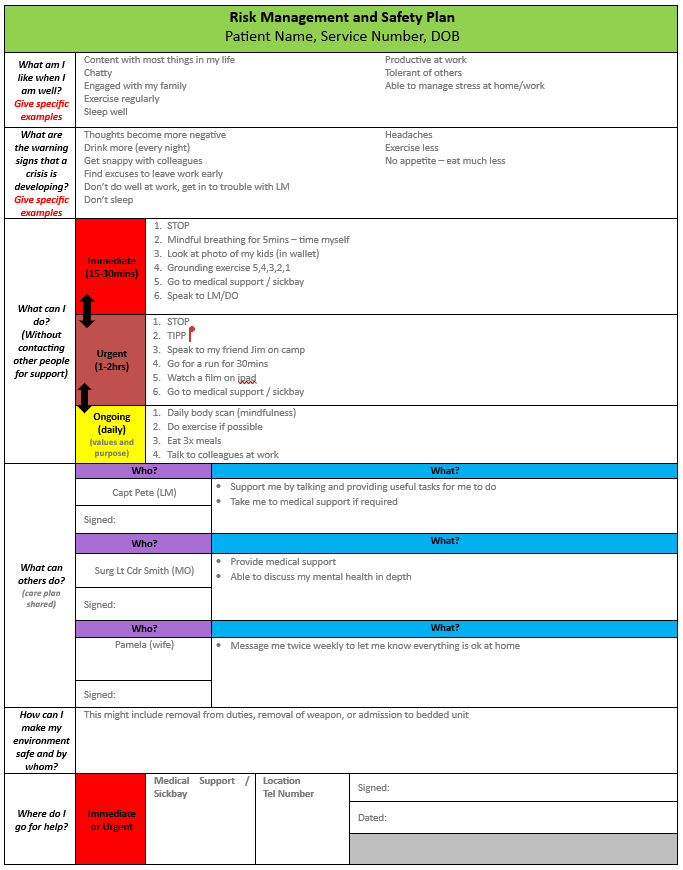
3. Development of an individualised safety plan. Safety plans, an example shown in accordion content below, are designed to engage the patient in thinking about their mental health, their risks, and putting in place simple measures to reduce these risks. They are primarily used to manage risks of suicide and self harm, and should be completed jointly between clinician and patient. They should be shared with CoC/Peers (with the patients consent) to further manage risk. In the operational context, a safety plan would likely be used to manage risks in the short term whilst other measures are being considered (such as aeromedical evacuation). The example in accordion content below is merely a demonstration of the type of plan that could be utilised.
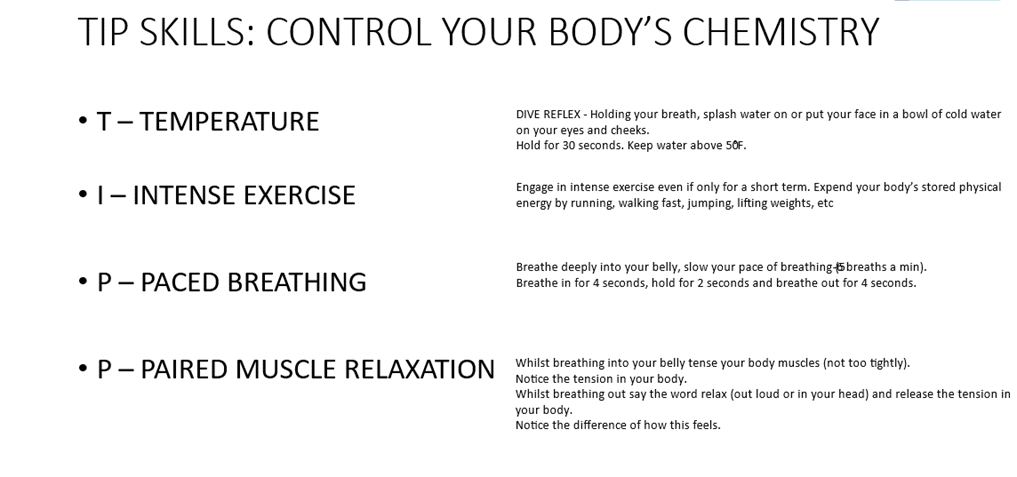
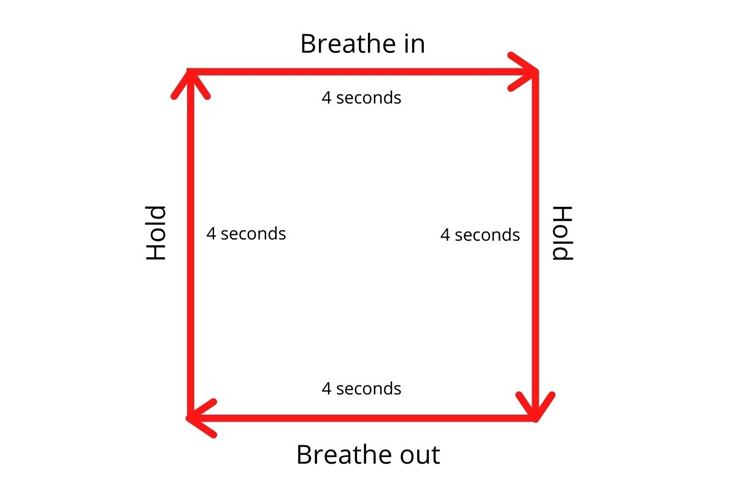
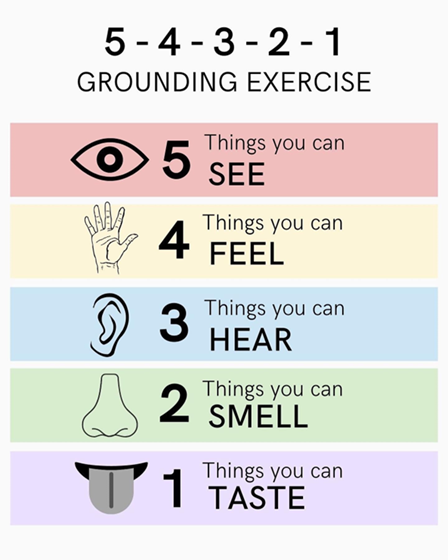
4. Teaching of immediate skills to manage acute distress. In the operational setting it is likely that some immediate and direct skills to manage emotional distress and acute anxiety will be of benefit. Examples of such skills are in Brief Resource Intervention at Assessment below. They have been chosen as they are effective, easy to learn, and can be used in combination.
5. Liaison with CoC/Executive. On operations it is essential that there is engagement with the CoC. Especially when it comes to advice on risk. Engagement is required to manage risks but is of benefit in providing reasonable work adaptions (such as removal from guard or night duties), to arrange aeromedical evacuation, or for welfare considerations. Wherever reasonably practicable engage with the patient to gain their permission to share information (and enquire which medical information they are content to be shared). Caldicott principles should be adhered to, alongside operational considerations and the wider safety of the unit/platform.
6. Aeromedical evacuation. Capacity and consent, in-flight safety of patient and escort, and type of escort if required will form part of the mental health assessment if the patient is unsuitable to remain in theatre. Within AECC there is a duty MO and MH CPN available to speak with for support around aeromedical evacuation decisions. When planning aeromedical evacuation, there should be consideration of onward risk management and treatment in the Strategic Base.
Other Considerations
Women of childbearing age. The mental health assessment does not differ for women of childbearing age, nor for pregnant or post-partum women. Consider early reach back support from a mental health professional for this group of patients, particularly in the post-partum period, as mental health symptoms can evolve rapidly during this time.
Paediatric Considerations
Paediatric casualties. The mental health assessment does not differ for children, however the language used during the assessment should be appropriate to the age of the child. Wherever practicable the child should be kept with, and assessed with, their family unit. Collateral history from someone who knows the child well is of value. Reach back support from a mental health professional should be sought early.