
Tetanus-Prone Wounds

Warning

Objectives

To guide identification and management of tetanus-prone and high-risk tetanus-prone wounds.

Scope

This guideline covers the recognition and post-exposure management of tetanus-prone wounds. It does not cover methods of wound closure or dressing which can be found in separate guidelines.

Tetanus-prone wounds include animal bites in the deployed setting; in such cases please also consult the CGO for human and animal bites which includes guidance on managing possible exposure to rabies.

Audience

This guideline is intended for the use of registered healthcare professionals fulfilling a general role in forward medical locations or in an Emergency Department on deployed operations.

Initial Assessment & Management

Any wound can give rise to tetanus however clean wounds are considered to have a low likelihood of containing tetanus spores and the conditions for tetanus spore germination. Immediate post exposure treatment is not required for clean cuts/wounds.

A clean wound is defined as:

  • Less than 6 hours old
  • Non-penetrating
  • Negligible tissue damage

Tetanus-prone wounds include:

  • Puncture-type injuries acquired in a potentially contaminated environment
  • Wounds containing foreign bodies
  • Open fractures
  • Wound or burns with systemic sepsis
  • Animal bites and scratches

A contaminated environment is one in which tetanus spores could be present; for the purposes of deployed operations, this is likely to include most environments with the possible exception of clean clinical or food preparation areas.

High-risk tetanus-prone wounds include any of the above with:

  • Heavy contamination with material likely to contain tetanus spores such as soil or manure
  • Wounds or burn that show extensive devitalised tissue
  • Wounds or burns that require surgical intervention that is delayed for more than 6 hours are high risk even if the contamination was not initially heavy

First, thoroughly clean the wound.

Then, assess whether the wound is tetanus-prone or high-risk tetanus-prone.

Advanced Assessment & Management

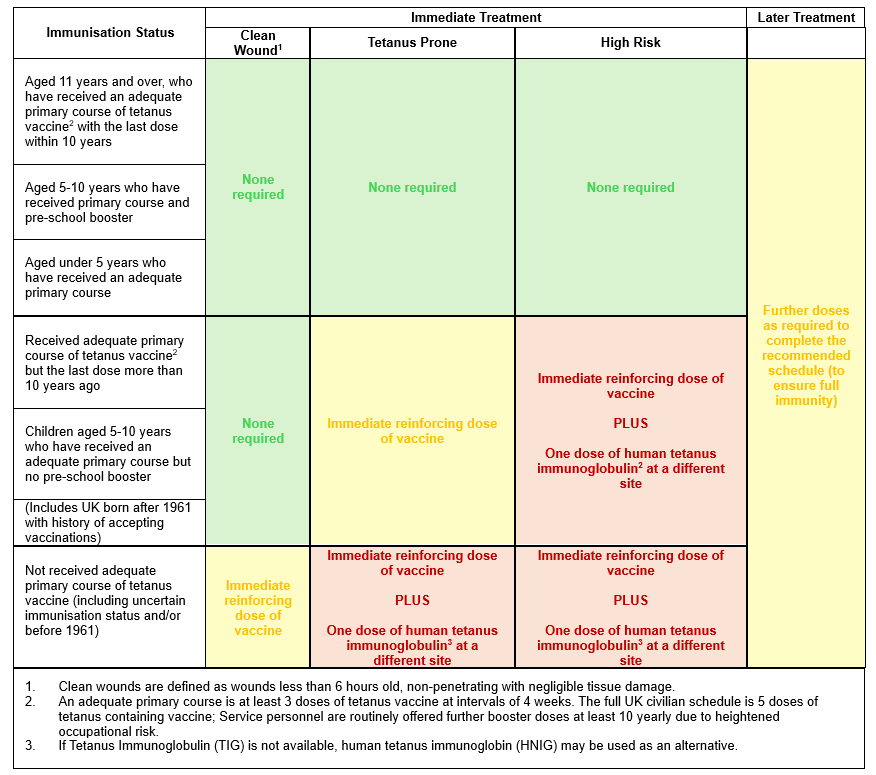
Fully immunisedIf the patient is aged 11 and over, has completed a 'priming' course of tetanus vaccine and has had a booster within the past ten years, no treatment is required for tetanus prevention. This should include most UK Service personnel.

Partially immunised

If the patient completed a 'priming' course of tetanus vaccine but has never had a booster dose or has not had a booster dose for more than ten years then:

  • Clean wounds require no further tetanus treatment - but consider an opportunistic booster if available and entitled.
  • Tetanus-prone wounds - administer an immediate dose of vaccine
  • High-risk tetanus-prone wounds - administer an immediate dose of vaccine and a dose of human tetanus immunoglobulin in a different site. 

Non-immunised

If the patient has not completed a 'priming' course of tetanus vaccine or immunisation status is uncertain then:

  • Clean wounds - administer an immediate dose of vaccine
  • Tetanus-prone wounds - administer an immediate dose of vaccine and a dose of human tetanus immunoglobulin in a different site. 
  • High-risk tetanus-prone wounds - administer an immediate dose of vaccine and a dose of human tetanus immunoglobulin in a different site.
If immunisation status is uncertain, treat as non-immunised.

Figure 1: Summary of Tetanus actions (click to expand)

Prolonged Casualty Care

Neither tetanus vaccine nor human tetanus immunoglobulin are normally available in forward medical locations, so patients who require either should be evacuated as soon as possible to a suitably equipped facility - likely to be deployed hospital care.

If prompt evacuation is impossible, thorough wound cleaning is paramount to minimise the risk of contamination until the patient can be evacuated and vaccine/immunoglobulin administered.

There is no need to evacuate a patient for opportunistic booster vaccine administration.

Paediatric Considerations

Children aged under 5 who have received a 'priming' course of at least 3 doses of tetanus vaccine, and those aged 5-10 who have received a 'priming' course and at least one booster dose may be treated as fully immunised.

Children aged 5-10 who have received a 'priming' course but no booster should be treated as partially immunised.

Children who have not completed a 'priming' course of three doses of tetanus vaccine should be treated as non-immunised.

Tetanus Immunisation in Service Personnel

Vaccination Programme

Tetanus immunisation has been routine in the UK since 1961. The immunisation schedule includes a 'priming course' of three tetanus immunisations, a pre-school booster at 3 years and 4 months old and a further booster at 14 years old, to a total of five doses.

Further boosters are not routinely administered in UK civilian practice unless an individual sustains a tetanus-prone wound and it is more than 10 years since last vaccine dose.

However, due to the heightened risk of occupational exposure, DMS policy at the time of publication is that UK Service personnel should be offered additional booster doses at 10 yearly intervals unless clinically contraindicated.

Follow-up for those who are not fully immunised

For patients who are not immunised but who sustain a wound and accept tetanus vaccination as per the guidance above, further tetanus immunisation doses should be offered to complete the schedule, as below:

  • If a primary course has already been started but not completed, resume the course – no need to repeat doses or restart course.
  • Otherwise if unvaccinated or unknown, the aim is to protect the individual in the shortest time possible: give three doses of tetanus vaccine with a minimum 4-week gap between doses. This will deliver an adequate primary course. This should be followed up with one booster dose at 5 years after primary course and then a further booster at 10 years (minimum 5 years) following the first booster.

Animal Bites

UK guidance is that only "certain" animal bites are considered tetanus-prone, noting that bites from domestic pets are unlikely to involve saliva that contains tetanus spores unless the animal has been routing in soil or lives in an agricultural setting.

However, in the deployed operational context, all animal bites should be considered tetanus-prone.

In addition, please consult the CGO on animal bites for advice on management of other aspects of such wounds including antibiotic prophylaxis and potential rabies exposure.

Last reviewed: 13/10/2026

Next review date: 13/10/2027