
Malaria
Objectives
This guideline provides Defence Medical personnel with a guide to suspecting, investigating and treating malaria in the deployed setting.
Scope
This guideline covers the major presenting features of malaria and an outline to investigating and treating a patient with suspected or confirmed malaria. Infection specialist advice is likely to be useful with suspected or confirmed cases of malaria.
Initial Assessment & Management
Introduction
Malaria is the most important tropical parasitic infection. It is preventable and treatable yet still causes between 250-300 million cases per year, and around 500-600,000 deaths. It is spread by the female anopheles mosquito, which bites from dusk until dawn, and is predominantly a disease of the rural tropics. There are 5 major species of the protozoal parasite that are transmitted in humans. Falciparum malaria is the most severe species, and causes significant mortality globally, and can cause cerebral malaria. Vivax and ovale may cause recurrent malarias due to their hypnozoite phase in the liver. Malariae and knowlesi are both caused by rare parasites.
Malaria is present globally throughout the tropics, with the highest rates of malaria in rural East and West Africa. Malaria is also present in large parts of South-East Asia, some areas of South America, and is parts of central Asia and the Middle East. Up to date malaria maps should be consulted prior to and during deployments to quantify exact risks.
Service persons have developed malaria, including life threatening cases while on operations, while travelling and when back in the Firm Base. Service persons are often frequent travellers, and the incubation period is such that they may present with malaria from previous travel/deployment, even when deployed in a non-endemic area. Foreign and commonwealth service persons have unfortunately not always taken malaria prophylaxis when travelling to their country of birth, even when it is in a malaria endemic area and this has led to recent cases on their return to the UK, or subsequent deployment.
Presentation
Malaria presents with a fever. All patients with a fever, or history of fever who are in endemic areas or who have been in endemic areas must be investigated for malaria.
Other common features include muscle ache, headache and general malaise. More specific features such jaundice and GI disturbance may be present, but not universally. Examination findings are usually non-specific.
In malaria‑endemic settings, the differential diagnosis for a febrile patient is broad. Clinicians must consider organ‑specific infections such as pneumonia, meningitis, and urosepsis, as well as causes of undifferentiated fever including typhoid, rickettsial infections, and arboviral illnesses. Rapid exclusion of malaria is a clinical priority, but assessment for alternative causes should proceed in parallel. A detailed history and examination help direct investigations toward non‑malaria aetiologies, and clinicians should use the Undifferentiated Febrile Illnesses Clinical Guidance Overview (UFI CGO) to support ongoing management while malaria is being ruled out.
Severe disease, including cerebral malaria, may cause seizures, coma, respiratory distress, shock or haemaglobinuria/renal impairment. Patients presenting to military medical care with these features and a potential exposure to malaria should be tested urgently.
Investigation
Investigation focusses on two aspects, firstly confirming or excluding a malaria diagnosis & secondly assessing for species and severity of malaria to guide further management. Investigation of others causes of a fever in the tropics is covered in the UFI CGO.
Pre-hospital malaria diagnosis may be performed using rapid diagnostic tests (RDTs). These have a good sensitivity, >90% for falciparum species, but somewhat less for non-falciparum species, and are easy to use. These should be carried at R1 in malaria endemic deployments. There are falciparum mutants that can escape detection by RDTs, therefore all malaria cases should have a blood film where practically possible- any concerns for these mutants should be discussed with an infection specialist. Tests should be repeated at least once if negative, and as false negatives have been reported if there is a high index of suspicion then advice from infection specialists sought.
In deployed hospital settings, a combination of microscopy by trained biomedical scientists and RDTs will be used, which in combination has high sensitivity and specificity. 3 blood tests should be sent. If there is a high index of suspicion but negative tests then advice from infection specialists should be sought.
With malaria, the platelet count is almost universally low, and this feature, along with a mildly raised bilirubin may be helpful.
Once malaria has been confirmed, the species & parasite count should be evaluated, which usually requires microscopy and a trained biomedical scientist so is only available in deployed hospital care.
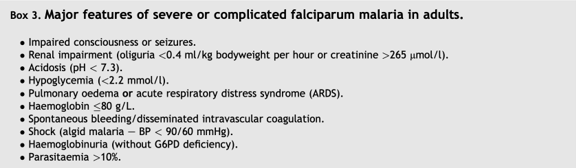
For confirmed falciparum malaria, assessment should focus on looking for the features of severe or complicated malaria (Box 3). Where these are difficult to perform in a deployed setting, for example, a pH level may not be available at R1, clinical assessment should look for corresponding physical signs eg tachypnoea.
Management
Malaria is a severe, life‑threatening infection that requires immediate treatment. Any delay in diagnosis or initiation of therapy significantly increases the risk of death or permanent disability. Urgent input from military infection specialists is strongly recommended, and clinicians should refer to the relevant national guidelines for definitive management (see reference below).
Treatment should occur in a hospital setting whenever possible. Only when essential operational constraints prevent timely evacuation or admission should care be initiated outside a hospital, and in such circumstances specialist advice must be sought without delay.
Drug treatment
Non-falciparum malaria
P.vivax/P.ovale/P.malariae/P.knowlesi:
Artemether-lumefantrine (Riamet) If weight >35 kg, 4 tablets then 4 tablets at 8, 24, 36, 48 and 60 hours.
OR Chloroquine (base) 600mg PO then 300mg 6h later then 300mg OD for 2 days
Non-severe falciparum
1st Line: Artemether-lumefantrine (Riamet) If weight >35 kg, 4 tablets then 4 tablets at 8, 24, 36, 48 and 60 hours.
2nd line: Oral quinine sulphate 600 mg 8 hourly for 5-7 days plus doxycycline 200 mg daily (or clindamycin 450mg 8 hourly for pregnant women) for 7 days.
3rd line: Malarone 4 tablets daily for 3 days
Riamet is preferred and should be stocked in deployed medical care when malaria might present. Malarone should generally be avoided where it has been used for prophylaxis, except in extremis.
Severe falciparum malaria
Artesunate 2.4 mg/kg IV at 0, 12 and 24 h then daily thereafter (maximum 5 days)
This is the preferred treatment option. It should be carried in deployed hospital care when malaria might present, and carries a morbidity and mortality benefit over other option.
If artesunate not available quinine 20mg/kg IV (max 1.4g) infused over 4 hours then 10 mg/kg every 8 h for first 48 hours (or until patient can swallow) can be used as second line.. Frequency of dosing should be reduced to 12 hourly if intravenous quinine continues for more than 48 hours. This requires careful monitoring for hypoglycaemia, and is not as effective as artesunate.
Following a minimum of 24 hours of intravenous artesunate or quinine, and once patients have improved and are able to take oral medication, a full course of Riamet should be given and completed.
General management
Patients with malaria should be managed in a hospital setting with appropriate expertise, experience and equipment to safely manage them. Patients with severe or complicated malaria should be managed in a high-dependency or intensive care environment.
Patient should be monitored for features of severe malaria, which will likely include daily bloods including U&Es, FBC, LFTs and monitoring for response to treatment, which involves a clinical response, and clearance of parasites as measure by the parasite count.
In patients with delayed or absent clinical or parasitological response to treatment then drug resistant malaria should be considered. This is a clinical diagnosis, and no deployed tests are available, beyond a lack of parasitological response to treatment. All cases of suspected should be discussed with an infection specialist. Current national treatment recommendations are at reference 3.
Advanced Assessment & Management
Follow up
Patients may be discharged from hospital care when they have parasitological and clinical response to treatment.
P.vivax/P.ovale: These malarias can relapse, months or years after infection. Treatment with primaquine is required to prevent relapse. Caution is required in Glucose-6-phosphate dehydrogenase deficiency, and testing this may necessitate treatment with primaquine being delivered in the firm base. R4 military Infectious Diseases clinics can deliver this.
P. falciparum: Haemolysis occurs in 10-15% patients following intravenous artesunate treatment, and can lead to significant anaemia. Haemoglobin concentrations should be checked approximately 14 days following treatment and this can be done in a deployed or firm base setting.
Public Health & Infection Control considerations
All cases of malaria in service persons should be notified to Public Health using an FMed 85. This allows follow up of cases, and analysis of why malaria prevention efforts have not worked. Informing the chain of command is prudent in deployed settings so malaria prevention efforts can be redoubled.
There are no infection control precautions with malaria patients, though they should be nursed in a bednet, or other mosquito free environment while in an area where anopheles vectors are endemic, to prevent secondary cases.