
Acute Renal Failure

Warning

Objectives

These pages are designed to inform the general clinician about the management of renal disease on military operations, to outline some of the more common presentations of renal disease that might be encountered in the deployed setting, and to provide a framework towards safe management of these patients. Specifics and further guidance is readily available through established reach back mechanisms including Pando (via DCA Med).

Scope

Diagnosis, Investigations, Management and Onward Care with regards to common abnormalities of renal function including: 

    • Abnormal Creatinine 
    • Proteinuria 
    • Haematuria 
    • Hypertension 

Audience

Clinical decision makers at Roles 1 - 3 including Doctors, Nurses, Paramedics 

Initial Assessment & Management

Acute renal failure is frequently a consequence of other pathologies. Consequently, some of what follows may be duplicated in other guidelines including Heat illness, Major trauma, and electrolyte imbalances.

ABNORMAL CREATININE

An abnormal creatinine may be the first indication that a patient has renal impairment. The whole assessment includes a thorough history and examination as well as monitoring for other markers of renal dysfunction, including;

  • BP
  • Urine dip
  • urinary output monitoring

in the role 2-3 environment these can be supplemented with 

  • Urea and electrolytes
  • Urinary Albumin Creatinine Ratio (uACR) where available in host nation facilities. This is valuable in detecting early glomerular injury, and if not readily available should be undertaken when the patient reaches a fixed laboratory facility.

Much will depend on the cause and reversibility of renal impairment. For the purposes of this CGO an acute abnormality will be the focus. However, please be aware that a background of CKD may also complicate the picture in some individuals, and this may affect management. Reachback is available through DCA, who may advise directly or seek input from CA Renal or the Deployed Dialysis Lead. All service Nephrologists are also available to give advice via Pando. 

Advanced Assessment & Management

CAUSES OF RENAL IMPAIRMENT

Pre-renal/hypoperfusion/volume depletion

Dehydration secondary to poor intake, GI losses, blood loss, burns, third-space loss such as effusions, ascites and peripheral oedema, vasodilation from sepsis or anaphylaxis, reduced cardiac output, hepatorenal syndrome, and renal artery aneurysm or stenosis. 

Intrinsic renal disease

An abnormal process within the kidneys; which may include glomerular pathology (glomerulonephritis which may be a primary renal disease or part of a systemic or autoimmune process or associated with certain infections). Tubular and interstitial pathologies (drug-induced or secondary to renal infection, including TB). Vascular pathologies such as vasculitis. Oedema from renal vein thrombosis.  

Post-Renal

Impeding drainage of urine from one or both kidneys; this would include tumour, stone, trauma or papillary necrosis. It may also include bladder outflow obstruction because of an enlarged prostate or extra-renal masses such a lymph nodes or tumours of ovary, colon or endometrium or retroperitoneal fibrosis. 


ASSESSMENT

  • Baseline bloods include Urea and electrolytes, bicarbonate, blood gas, FBC, LFTs, CRP.
  • For suspected rhabdomyolysis consider CK, calcium and magnesium monitoring.
  • Consider glucose, HbA1c, TFTs or relevant viral screens if the history points towards these causes.
  • For AKI, hourly input/output monitoring and Ultrasound of the urinary tract (where available) should be performed. Urine output can be measured without the insertion of a urinary catheter, but for those where hourly measurement is considered valuable (unwell patients with marginal renal function undergoing active resuscitation), catheterisation will be required.
  • Suspected pulmonary oedema may need confirmation with a CXR or point of care ultrasound. 
  • Obstructive uropathy will be confirmed with USSKUB but may require AXR or non-contrast CTKUB to confirm hydronephrosis and stone. (IVU and cystoscopy would need urology input). Please see section on ureteric colic


TREATMENT

  • Stop/ avoid nephrotoxic agents including NSAIDs, ACEi/ ARBs. 
  • Stop Creatine supplements and protein supplements until resolution of AKI. Whilst not nephrotoxic, creatine supplementation will raise measured creatinine without true GFR depression, making monitoring and treatment challenging.  Protein supplementation to supra-normal levels will elevate urea load, whose clearance will be reduced in an acutely injured kidney. 
  • For pre-renal causes, replacement of fluid, blood products and definitive surgery to stop ongoing blood loss will be relevant. With heat illness, cooling measures may also be necessary. The volume target should be euvolaemia.  
  • Intrinsic renal disease such a urinary tract infection will be treated with antibiotics such as co-amoxiclav or ciprofloxacin, unless MSU dictates otherwise. 
  • Glomerular pathology will need further investigation and treatment following discussion with a nephrologist and will likely require return to the UK.Obstructive Uropathy may need urological intervention, such as lithotripsy or ureteroscopy to remove stones, or interventional radiology to place a nephrostomy. These would need to be performed by, or discussed with a Urologist, or DCA surgery. Tamsulosin may be beneficial for smaller stones. 


ONWARD CARE

  • Any AKI that fails to resolve reasonably quickly or which is secondary to any other severe illness or injury will need to return to the UK.
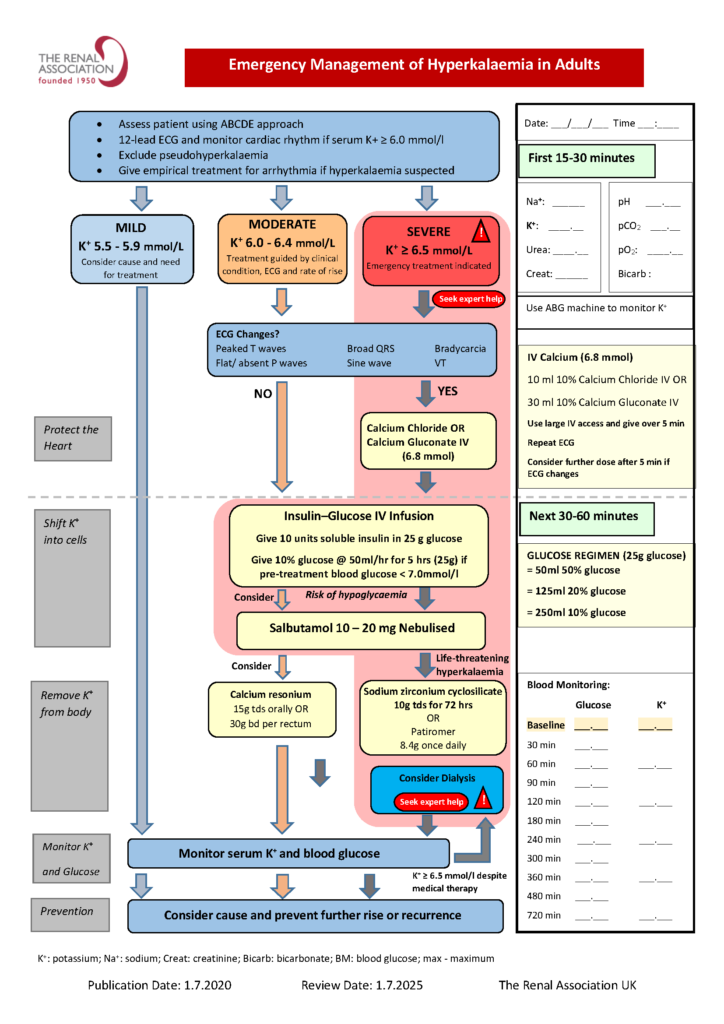
  • Any requirement for dialysis (refractory or severe hyperkalaemia, acidosis, uraemia or concurrent pulmonary oedema and fluid overload) will need urgent discussion with DCA and the Deployed Dialysis Lead as well as with AECC. CCAST have a haemodialysis capability which can be deployed for use before and during evacuation.
  • As above, any Obstructive uropathy that cannot be resolved will need return to the UK or another suitable facility. Please see section on ureteric colic.

Prolonged Casualty Care

Please note, this may overlap with sections on critical care and electrolytes. After the original trauma and potential primary surgery, patients may be at risk of ongoing blood loss, dehydration, (especially in burns patients), sepsis, rhabdomyolysis and potentially poisoning/ toxic side effects of medication given. 

These patients will likely require critical care involvement and expedient aeromedical evacuation. In the interim such patients will need; 


  • Strict fluid input/output monitoring
  • Daily (potentially more frequent) monitoring of Us+E, calcium, magnesium and bicarbonate, CK, lactate
    Ongoing management of infection
  • Rationalisation of opiate doses in the context of any renal impairment, and drug/antibiotic levels where relevant.


Hyperkalaemia – EMbeds.co.uk


Paediatric Considerations

Other relevant guidance is available in the “Page for Age” section of the CGO’s. Please also see the below excerpt from NICE Guidelines about fluid resuscitation in children. 

NG29 Algorithms for IV fluid therapy in children and young people in hospital (nice.org.uk) 

Intravenous fluid therapy in children and young people in hospital (nice.org.uk) 


Presentations of renal conditions in children 

Proteinuria in children is more likely to be minimal change disease and is more likely to be treated empirically without biopsy. A classic rash with non-visible haematuria may be Henoch-Schonlein Purpura with IgA Nephropathy, which may also be managed without biopsy. However, none of these should be managed by a non-specialist without discussion with a Paediatrician. Any entitled dependents would need to be referred to local secondary care or brought back to the UK if this was not an option. 

UTI in children will need to be confirmed with an MSU and may require imaging to look for evidence of scarring or reflux. This should be discussed with paediatrics. 

Acute Kidney Injury

Causes of impaired renal function

These are classified into three groups:

  • Pre-renal = poor renal perfusion (best sign: hypotension especially if this is postural)
  • Renal = nephritis (best sign: urinary dipsticks show blood, protein or both)
  • Post-renal = obstruction (best sign: obstruction on ultrasound).


Indications for renal replacement therapy(haemofiltration, dialysis etc)

  • There are four indications for renal replacement in the presence of severe AKI. 
    • Fluid overload (pulmonary oedema)
    • Hyperkalaemia ([K+]>6.5mmol/l)
    • Urea>40mmol/l
    • Metabolic acidosis ([HCO3-]<12mmol/l).


Diagnosis and treatment of oliguric AKI

Most causes are medical, usually due to reduced renal perfusion following hypotension (secondary to absolute or relative hypovolaemia), but nephritis is a possibility.

Normal urine output is about 1500mls/24hrs = 60ml/hr

AKI = 400ml/24hrs = 18.5ml/hr

  • Hourly urine output; renal function tests (especially serum creatinine) should be monitored regularly in seriously ill patients as soon as medical assessment commences, especially in patients who have suffered trauma, burns or infection who are at particular risk.
  • Treat the underlying cause and prevent ongoing injury.
Proteinuria

Proteinuria is likely to first be identified on a urine dip. If possible, a more accurate result should be obtained via uACR. This is done via a universal, white-top container from a first morning sample and gives an indication of the amount of protein lost over 24 hours, using spot testing. 

Normal to mildly increased 

<30mg/g or <3mg/mmol 

Moderately increased 

30-299mg/g or 3-29 mg/mmol 

Severely increased 

>300mg/g or >30mg/mmol 


Moderate proteinuria (ACR >30mg/g or 3mg/mmol) is more likely to be an indicator of underlying renal pathology, which can be due to intrinsic renal disease or secondary to a systemic illness. Unlike an AKI, which may resolve with IV fluids, it is more likely that this will persist and may require further specialist investigation, including potential kidney biopsy, and treatment which may include immunosuppression. A deployed individual with proteinuria may need to return to the UK for full investigation. If there is heavy proteinuria, features of nephrotic syndrome or other abnormalities in renal function then this may need to expedited rapidly via the aeromedical evacuation chain. 

Heavy protein loss may be accompanied by clinical features including facial oedema, pedal/ dependent oedema and, in more extreme cases pulmonary oedema.

Nephrotic Syndrome

  • Nephrotic syndrome is characterised by protein loss of >3-3.5 g in 24 hours (uACR> 220mg/mmol), serum albumin <25 and oedema.
  • It may also be accompanied by elevated serum cholesterol, which should be treated with a statin, and may confer an increased risk of VTE which should also be mitigated against with appropriate anticoagulation.
  • High dose steroids, with bone protection and GI protection will likely be given prior to a biopsy, but this would not be expected of any non-specialty healthcare professional in a deployed setting without discussion with a nephrologist


Haematuria

Most cases of visible haematuria will be caused by trauma, infection, tumour or stone and may originate in the kidneys, ureters, bladder or urethra. These conditions may require urology advice and will certainly require imaging such as USSKUB, CTKUB or cystoscopy. A small stone which has passed, or a treatable, uncomplicated lower UTI may be managed in theatre. Obstructing calculi, complex infections such as pyelonephritis/ pyonephrosis or trauma will need Urology input and will likely require medical evacuation back to the UK unless an appropriate facility exists in theatre. Proven or suspected tumour will need medical evacuation to the UK. 

The above-mentioned conditions may also cause non-visible, or microscopic haematuria, blood found only on the urine dip. However, if this is found in the absence of any history or radiological findings that suggest a urological cause, then renal disease such as glomerulonephritis may be the cause. In most cases this will be a chronic disease (lasting more than 6 weeks). This may require immunological investigations as well as potential renal biopsy. Much of these are not available in the deployed setting and medical evacuation to the UK is recommended. It would not be appropriate for a non-specialty doctor, or allied healthcare professional, to commence empirical steroids without discussing with a nephrologist first, so treatment options for GN have been intentionally omitted from this section. 


In a permissive overseas environment, which has access to local secondary care for more specialist bloods and imaging, when a normal or mildly abnormal creatinine (CKD 1-2) is found in conjunction with minimal proteinuria (ACR<30) or blood on urine dip in an otherwise clinically well and asymptomatic individual; it is sometimes feasible for local investigations (excepting renal biopsy) to be conducted under remote supervision of a service nephrologist and for that individual to remain in theatre. This would not be the case if any immunosuppression were likely to be needed. Consider contact with DCA or with service nephrology via Pando

Secondary Hypertension

For the purposes of the deployed setting, investigations of secondary causes of hypertension have not been included in this section as they may not be available and management would be to concentrate on BP control and evacuation to the UK for secondary care oversight of relevant investigations. 


In cases where secondary hypertension is suspected, such severe hypertension in young patients (<40 years old), LVH on ECG, proteinuria on dip, retinal haemorrhages on fundoscopy then reach back from nephrology or cardiology should be sought and consideration of evacuation. Treatment should not be delayed because of secondary hypertension investigations.  


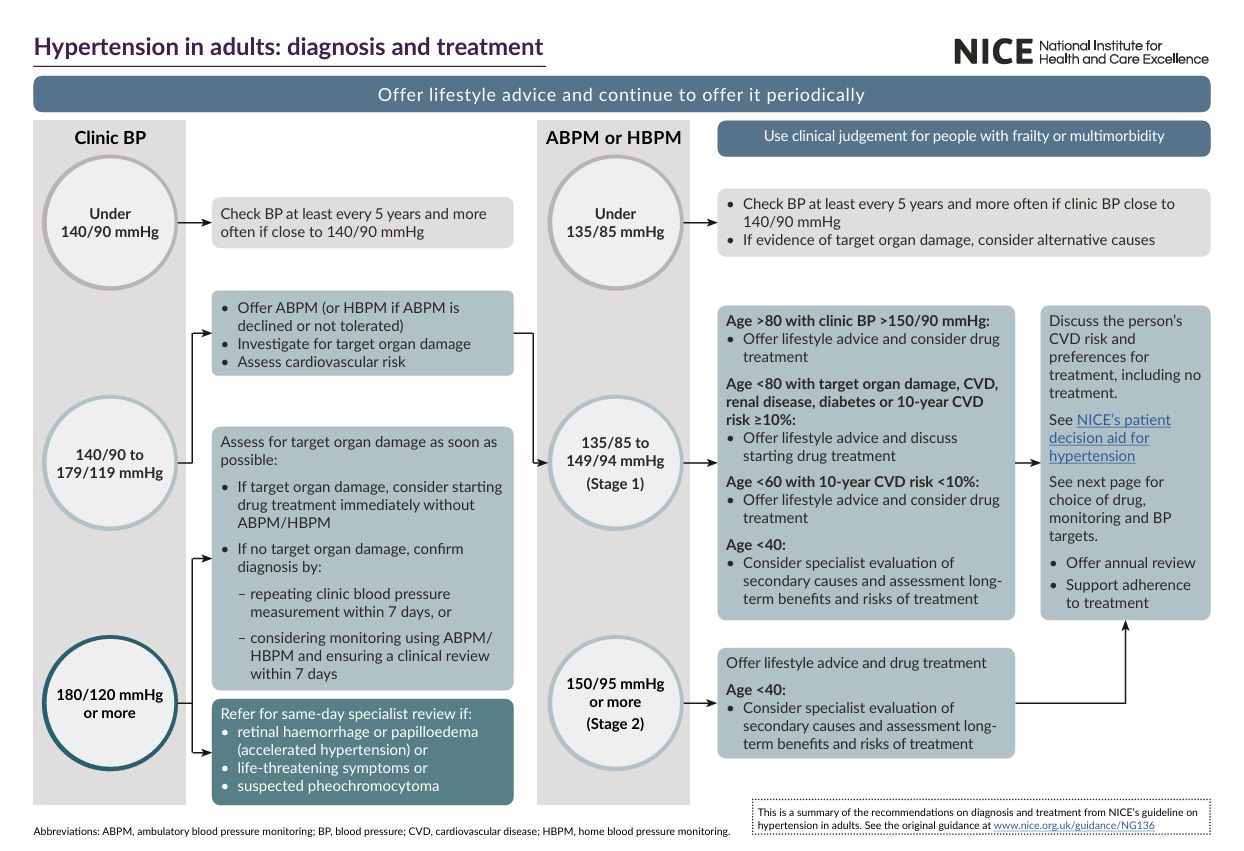
Outside of this setting, hypertension should be assumed to be primary and managed according to NICE guidelines. Most primary care physicians should be accustomed with these, but are copied below for ease of access.

A diagram of a patient's diagnosis

Description automatically generated


A diagram of a patient's medication

Description automatically generated


Last reviewed: 30/05/2026

Next review date: 30/05/2027

Version: 1.0