
Spider bites
Objectives
To provide an evidence-based approach to management of spider bites in the operational environment.
Scope
From point of bite first aid to prolonged management in deployed hospital care
Audience
This guideline is intended for the use of registered healthcare professionals fulfilling a general role in forward medical locations or in an Emergency Department on deployed operations.
Initial Assessment & Management
Spider Bite
Overview
Almost all spider species produce venom but the vast majority do not cause clinically significant effects due to lacking the combination of sufficiently potent venom and a venom injecting apparatus to penetrate human skin.
A spider is seen in a minority of cases, making diagnosis of spider bite often reliant on history and recognising a distinctive pattern of envenoming, and giving rise to many false attributions and incriminations of harmless peri-domestic spiders.
Initial management
Conduct an initial MARCH assessment in accordance with principles of casualty management.
Be prepared to treat anaphylaxis to venom using the standard pathway. Anaphylaxis CGO
Most bites are minor and can be managed by wound care, ice packs or cold compresses (for no longer than 20 minutes), and the following additional steps:
Caution: prolonged application of ice packs or cold compresses can cause frostbite
Analgesia: depending on severity of pain, paracetamol, NSAIDs, and opioids can all be used in doses similar to that for other acutely painful disorders. Analgesia CGO
Assess tetanus status and administer vaccine and/or immunoglobulin, if required.
Secondary infection of bites (e.g. cellulitis) is rare but may require antibiotics in accordance with Antimicrobial Formulary.
Very rarely do spider bites cause a severe envenoming syndrome. Geographical location of clinically significant venomous spider species:
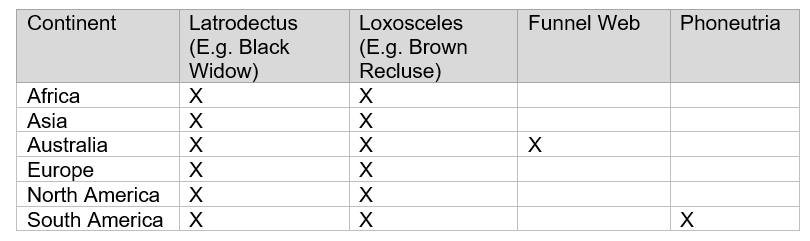
Whilst certain species of spiders may be found in only certain geographic regions, spiders are sometimes found in the cargoes of imported fruits and are also kept as pets. The Phoneutria species as an example, are also known as banana spiders having been known to be transported in boxes of bananas. Latrodectus and other species have been inadvertently introduced, e.g. to Scandinavia and Japan.
Reach-back advice is available through Pando (ID Infection & Trop Med) or NPIS 0344 892 0111. Toxbase also provides comprehensive management advice on venomous spiders.
Widow Spiders (Latrodectus)
Identification
Small to medium size spiders, generally black or brown with a red or yellow demarcation on their ventral and/or dorsal globular abdomen. A lack of a red or yellow demarcation on the spider does not exclude it from being a Latrodectus species.
Toxidrome
Neurotoxic. Excitatory alpha-latrotoxins result in activation of the nervous system and neurotransmitter release. There is substantial variation in clinical effects between species, ranging from predominantly a pain syndrome in Australasia to a more systemic illness with the European and American widow spiders, with painful muscle spasms, generalised sweating and, rarely, myocardial effects.
History
Pain
The bite is initially painless or a pinprick sensation.
Painful muscle cramping is an almost universal feature beginning within 15-60 minutes following the envenomation.
Pain may radiate from the bite-site to regional lymph nodes, proximal limb, abdomen, chest or back.
May last hours to days.
Generalised symptoms
Non-specific symptoms: nausea, vomiting, headache and fatigue.
Examination
Local
A pair of small red spots (fang marks) may be visible (5%).
Erythema, piloerection and sweating.
Muscle fasciculation and patchy paralysis.
Systemic
Sweating – may be in unusual distributions.
Other autonomic effects including tachycardia, hypertension (often profound), agitation, and irritation.
Priapism may occur.
Rarely rhabdomyolysis, myocarditis.
Investigations
Laboratory investigations are rarely needed. If available, FBC, U&Es, LFTs, coagulation and cardiac markers can be assessed. Electrolyte abnormalities can occur and may be exacerbated if the patient is dehydrated.
Role 1 Treatment
Application of an ice or cold compress (for no longer than 20 minutes) may lessen pain.
Pressure immobilisation is contra-indicated.Analgesia should be offered.
Benzodiazepines may improve muscle spasms.
Check blood glucose (transient hyperglycaemia can occur).
Perform a 12 lead ECG if available.
Basic wound care (to include tetanus prophylaxis if indicated).
Prophylactic antibiotics are not routinely recommended.
Analgesia and benzodiazepines are often sufficient to manage tachycardia and hypertension.
All patients should be observed for at least 6 hours after exposure. Patients who are asymptomatic at this time can be considered for discharge with advice to return if symptoms develop - it is recommended that before discharge, cases are discussed via Pando or NPIS.
Minor bites should be followed up over 24-48 hours to identify infection or progression of symptoms.
Symptoms may fluctuate in severity for up to 4 days and may last up to 2 weeks.
Seek further reach-back advice and refer to higher level of care if the patient develops signs of systemic illness.
Role 2/3 Treatment - Antivenom
The effectiveness of antivenom is controversial and must be based on a risk-benefit assessment with specialist advice sought via reach-back using Pando (ID Infection & Trop Med) or NPIS 0344 892 0111. Acute reactions are reported in about 5% of cases, including anaphylaxis in up to 2%. It should usually be reserved for patients with severe or systemic symptoms.
Prognosis: Fatalities are rare and when they do occur, are secondary to cardiac arrest (from severe hypertension with predisposing medical conditions) and wound infection.
Recluse Spiders (Loxosceles)
Identification
Loxosceles are small (body length 8-15mm), brown- or fawn-coloured nocturnal spiders with long, slender legs. Often known as violin or fiddleback spiders because of a marking on the cephalothorax. Most bites happen at night when the spider is trapped against the person, often on the extremities, such as while putting on a boot, or when using a sleeping bag that a spider is trapped in.
Toxidrome
Cytotoxic. The pathogenesis of loxoscelism (the term used to describe clinical manifestations of Loxosceles bites) is not fully understood but the key components in venom is phospholipase D, which is involved in the development of dermonecrosis; and hyaluronidase that increases the size of the tissue lesion, which is a hallmark of loxoscelism. Other toxins include: Loxnecrogins A and B; and Loxolysins A and B.
History
Pain
Bites are often initially painless and at night.
Within several hours: pain, swelling, erythema and tenderness at bite site that may blister.
Generalised symptoms
Generalised pruritus and morbilliform rash, headache, nausea, vomiting, myalgia and low-grade fever, may present in the first 24-72 hours after envenomation.
Examination
Local
The classic sign of loxoscelism is the “red, white and blue sign”; a halo of erythema (vasodilatation) (red), an inner ring of vasoconstriction (white) and a central area of pre-necrotic cyanosis (blue). The lesion may spread gravitationally with serous or haemorrhagic vesicles/blisters.
Large and deep necrosis occurs in more than half of cases from 72 hours. Bites that are in fatty areas, such as the thigh or buttocks, tend to cause more extensive necrosis.
From about day 5-7, a dry well defined necrotic eschar forms, which will detach after about 2-3 weeks leaving an ulcer with tissue of granulation, which can take weeks-months to heal, dependent on the depth and extent of injury.
Bites to the face may results in an oedematous variant of cutaneous loxoscelism that is characterised by extensive oedema and erythema, but little necrosis.
Systemic
Systemic loxoscelism is much less common than the cutaneous form. Acute intravascular haemolytic anaemia (over 7-14 days) is the hallmark feature of systemic loxoscelism. Coagulopathy (including thrombocytopenia and disseminated intravascular coagulation), rhabdomyolysis, acute kidney injury, multi-organ failure, shock, and death may also occur.
Investigations
Laboratory investigation is not indicated for non-necrotising local symptoms.
Systemic loxoscelism: FBC, U&Es, LFTs, clotting, CK, LDH and blood gas. Urinalysis may reveal haemoglobinuria.
Elevated serum total bilirubin and LDH may be important predictors of clinically significant haemolysis. Haemoglobin has been reported to go as low as 5-8 g/L.
Differential Diagnosis
In the absence of a definite bite history or, if a bite has been felt, without identification of the offending creature, the diagnosis of necrotising arachnidism is circumstantial. Consider the many other treatable causes of dermal necrotic lesions, which are beyond the scope of this guideline.
Role 1 Treatment
Analgesia should be offered as necessary - application of an ice or cold compress (for no longer than 20 minutes) may lessen pain.
Basic wound care (to include tetanus prophylaxis if indicated).
Rest the affected area or limb.
Pressure immobilisation is contra-indicated.
Monitor vital signs and check blood glucose.
Perform a 12 lead ECG if available.
Prophylactic antibiotics are not routinely recommended.
Refer to higher level of care if the patient develops signs of systemic illness.
Antibiotics should be used if a secondary bacterial infection develops, although this is uncommon. Antimicrobial Formulary.
Refer patients to next level of care if expanding necrotic lesion or symptoms of systemic loxoscelism occur.
All patients should be observed for at least 6 hours after exposure. Patients who are asymptomatic at this time can be considered for discharge with advice to return if symptoms develop.
Role 2/3 Treatment
Specialist advice should be sought.
Antivenom may be of benefit after a bite to a child, in cases with significant local signs or necrosis, or in cases with severe systemic symptoms. However, clinical trial evidence of effectiveness is lacking.
There is no evidence for the routine use of antibiotics, corticosteroids, antihistamines, dapsone, transfusion, surgical debridement, skin grafting, dialysis, hyperbaric oxygen, therapeutic plasma exchange, or negative pressure wound therapy
Discuss cases of haemolysis, thrombocytopenia, or DIC with a haematology specialist.
Treat multi-organ failure with standard supportive measures.
Early surgical debridement is not recommended. Excision of the necrotic eschar may be appropriate if the lesion shows complications or limited and prolonged healing.
Funnel Web Spiders (Atrax, Hadronyche)
Identification
Funnel-web spiders mainly exist in a confined geographical region in eastern Australia and Tasmania have little interaction with human beings, except for the most notorious Sydney funnel web (Atrax robustus) that is common in the urban area. They are medium to large shiny black spiders (up to 3 cm in body length) that have prominent fangs.
Toxidrome
Neurotoxic. Delta-atracotoxins (previously known as robustotoxin) or delta hexatoxins (δ-hexatoxins) cause excessive release of acetylcholine, norepinephrine, and epinephrine; and eventual exhaustion of neurotransmitters that results in the characteristic biphasic clinical syndrome. After a bite, from 10 minutes to up to 1-2 hours, approximately 10-25% of patients go on to develop a rapid onset of severe systemic effect.
History
Pain
Very painful bite (due to size of fangs and acidity of venom).
Perioral tingling.
Generalised symptoms
Nausea, vomiting, profuse sweating, blurred vision.
Examination
Local
Puncture marks and bite site bleeding.
Piloerection, regional fasciculation which may progress to spasms.
Systemic
Autonomic excitation (adrenergic and cholinergic): profuse lacrimation and salivation, tachycardia, hypertension, and cardiac dysrhythmias.
Neuromuscular excitation: tongue fasciculations, muscle spasms.
Respiratory effects: dyspnoea with signs of non-cardiogenic pulmonary oedema leading to respiratory failure.
In the second phase of envenomation, refractory hypotension, apnoea and cardiac arrest may occur.
Consumptive coagulopathy.
Investigations
In all patients check FBC, U&E, LFTs, coagulation and CK.
Perform a 12-lead ECG in all patients who require assessment.
In patients with respiratory features, perform a chest X-ray.
Role 1 Treatment
Perform pressure bandage or pressure pad immobilisation (link to snake bite guideline – or copy here)
Admission to hospital care is required for observation and consideration of antivenom administration.
Funnel-web spiders are capable of inducing a severe and potentially fatal neurotoxic effects – evacuate to hospital care (with pre-alert) urgently.
All patients should be observed for at least 6 hours after exposure. Patients who are asymptomatic at this time can be considered for discharge with advice to return if symptoms develop.
Role 2/3 Treatment
Pressure immobilisation removal should occur only in appropriate resuscitation area with intravenous access in place and antivenom on hand. If a patient deteriorates, it should be reapplied.
Antivenom is highly effective and should be given urgently to any patient with severe envenomation.
Atropine (initial dose 0.6 mg) may be used to reduce salivation and bronchorrhoea.
Intubation and mechanical ventilation may be required in the presence of excessive secretions and non-cardiogenic pulmonary oedema. If secretions are not problematic and the patient is awake, non-invasive ventilation may be of benefit but CPAP may exacerbate hypotension.
Anticipate difficult airway due to excessive salivary secretions and violent fasciculations.
Fluid resuscitation should be used with caution the event of hypotension because of non-cardiogenic pulmonary oedema.
Relapse may manifest as dyspnoea secondary to noncardiogenic oedema, which usually responds to further antivenom (this should not be confused with iatrogenic pulmonary oedema as a result of intravenous overload, particularly in children).
If no symptoms or signs of envenomation have started 4 hours after the bite or removal of pressure bandage immobilisation, the patient may be discharged (most patients presenting to hospital will not have been envenomed) but this should first be discussed a local poisons information service.
All patients who have received antivenom should remain in hospital for at least 24 hours after the last dose of antivenom and until the complication for which the antivenom was given has resolved.
Phoneutria species (South American armed spiders, banana spiders, Brazilian wandering spider)
Identification
Phoneutria spiders are large extensively-haired spiders found predominantly in South America, Costa Rica and the Caribbean. Most of the clinically important bites of this genus occur in Brazil. The spiders display a characteristic behaviour when threatened of raising the front four legs, displaying their fangs, bristling leg spines, and continually moving in a rotating manner to always face the threat.
Toxidrome
Neurotoxic. A highly complex venom with mixture of polypeptides and biologically active molecules that affect ion channels and cause neurotransmitter release.
History
Immediate local pain (varying severity).
Paraesthesia.
Systemic
Nausea, vomiting, dizziness and visual disturbance.
Examination
Local
The classical signs are diaphoresis, oedema, fasciculation, and pilo-erection (“goose-flesh”).
Systemic
Tachycardia, hypertension (causing strokes), agitation, vomiting, salivation, severe (children) vomiting, diarrhoea, priapism, bradycardia, hypotension, cardiac arrhythmias, and acute pulmonary oedema.
Role 1 Treatment
Analgesia should be offered as necessary - application of an ice or cold compress (for no longer than 20 minutes) may lessen pain.
Local anaesthetic infiltration of the bite site is reported as effective.
Basic wound care (to include tetanus prophylaxis if indicated).
Rest the affected area or limb.
Prophylactic antibiotics are not routinely recommended.
Refer to higher level of care if the patient develops signs of systemic illness.
Antibiotics should be used if a secondary bacterial infection develops, although this is uncommon. Antimicrobial Formulary
Role 2/3 Treatment
Most cases are treated symptomatically. Antivenom is available but is rarely used, even in South America. In Brazil, where bites are common, IM dipyrone has proved effective.