
Consider seeking specialist advice via the ID reach back service:
Mod.id@nhs.net
01543 406706
Pando Ask Advice: DMS ID Infection & Trop Med
Update Jul 2026
New guidelines continue to be added.
The content will undergo continuous review by all our cadres.
Do use the search function on the app and website to make it easier to find relevant guidance.
Feedback on layout can be given below.
Saf
[Updated 1 Jul 2026]
To provide an evidence-based approach to management of a scorpion sting in the operational environment.
From point of sting first aid to prolonged management in deployed hospital care
This guideline is intended for the use of registered healthcare professionals fulfilling a general role in forward medical locations or in an Emergency Department on deployed operations.
Routine resuscitation: MARCH
Lay the patient flat and keep the stung limb still and splint if necessary. Remove rings and constrictive jewellery.
Do not apply pressure immobilisation bandaging in cases of scorpion sting.
Provide calm reassurance: scorpion stings often trigger significant anxiety which can mimic signs of systemic envenomation. Reassess physiological parameters following reassurance.
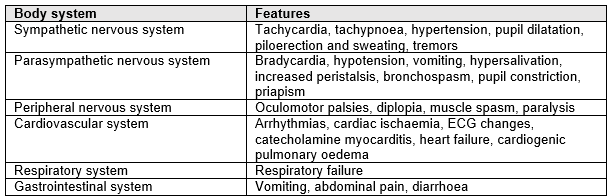
Assess for signs of systemic envenomation (see Table 1).
Typical presentation is of almost immediate pain and an early onset (within 15 minutes) autonomic syndrome, typically with agitation, hypertension and tachycardia. Onset may be delayed up to 4 hours.
Significant systemic envenomation is uncommon in adults who are at low risk of adverse outcome.
Pregnant women and young children are at increased risk of adverse outcome
Manage pain.
In 95% of cases reassurance and analgesia are the only required treatments.
Pain can vary from trivial and localised to severe and radiating and typically lasts for 10-15 hours (occasionally 24 hours).
Note that pain may cause tachycardia and hypertension. In cases of mild physiological disturbance consider pain management, reassurance, and reassessment of vital signs prior to evacuation/admission decisions.
Extensive experience has demonstrated that local anaesthesia is the single most effective analgesic modality – either via local infiltration around the sting site, or regional nerve block techniques. Repeat doses may be required.
Consider additional analgesia such as paracetamol and NSAIDs.
Ice pack application may be a helpful first aid measure.
Note that there is a theoretical risk of worsening autonomic symptoms with opioids and ketamine and these should be avoided where possible in cases of marked autonomic disturbance.
Risk assess for evacuation or admission.
In most cases reassurance and analgesia are the only required treatments.
In non-pregnant adults without signs of systemic envenomation and manageable pain consider discharge after 4 hours have elapsed from the sting.
Evacuation or admission is recommended if:
Signs of systemic envenomation
Uncontrollable pain
Children (smaller and younger children are at greatest risk)
Pregnant women
All patients with signs of systemic envenomation should be observed for at least 24 hours prior to discharge.
If available and can be safely obtained ask for a photograph or description of the offending scorpion. This information should accompany the patient to hospital to aid identification of scorpion species.
Do not encourage capturing or killing the scorpion!
Assess tetanus risk and give tetanus prophylaxis if required.
Record keeping
EpiNATO-2: Serial Mike (Bites and Stings)
Submit an FMed 85 notification to the Defence Public Health Unit
Most patients admitted to hospital following a scorpion sting will require pain control and reassurance, and monitoring for signs of systemic envenomation.
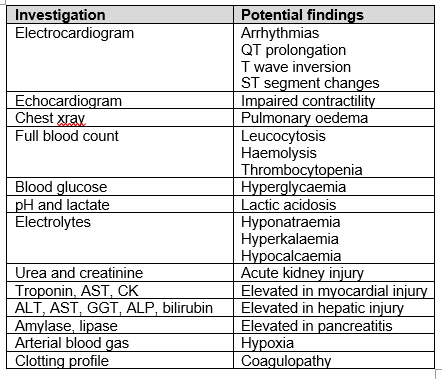
For patients with evidence of systemic envenomation, investigations (as available in the deployed setting) are recommended in the table below:
Manage pain
Local anaesthesia remains the mainstay of pain management following scorpion sting. Consider anaesthetic support for regional nerve block techniques with long acting local anaesthetic agents and multimodal analgesia.
Management of systemic envenomation
Patients with systemic envenomation should be managed in a critical care environment as deterioration can be sudden and dramatic.
For agitation, anxiety, and neuromuscular spasm consider use of benzodiazepines. In severe cases sedation may be required.
Standard ITU care should be provided for all patients with autonomic involvement, hypertensive crisis, cardiovascular instability, cardiogenic shock or pulmonary oedema with titratable intravenous treatment and organ support as required.
Atropine is NOT recommended for cholinergic symptoms and signs as it may exacerbate adrenergic toxicity
For other features of systemic envenomation treatment is supportive.
Antivenom.
For most species of scorpion there is no evidence of benefit but established risk of harm (including 1-2% anaphylaxis risk). Therefore, scorpion antivenom is not routinely procured for deployments nor a routinely recommended treatment.
Ongoing pain management will be the mainstay of treatment.
Repeat doses of local anaesthesia may be required.
Use multimodal analgesia.
Note that there is a theoretical risk of worsening autonomic symptoms with opioids and ketamine and these should be avoided where possible in cases of marked autonomic disturbance.
Almost all deaths from scorpion sting worldwide occur in children aged <10 years.
Children should be routinely evacuated to hospital and observed for at least 4 hours.
In children local pain from scorpion sting may cause tachycardia and hypertension which may mimic systemic envenomation.
Consider seeking specialist advice via the ID reach back service:
Mod.id@nhs.net
01543 406706
Pando Ask Advice: DMS ID Infection & Trop Med