
Lyme Disease

Warning

Objectives

To guide the initial assessment and subsequent management of patients presenting with suspected Lyme disease (Lyme Borreliosis) - an infectious disease caused by Borrelia bacteria and spread via tick bites - in the operational environment

Scope

This guideline covers the presenting features of the patient who may have Lyme disease and the subsequent initial empirical treatment and/or any required investigations and onward review.  If there is any diagnostic doubt or uncertainty then senior clinical opinion should be sought and involvement of a specialist with experience and training in Infectious Diseases may be required.

Further information on prevalence and epidemiology can be found via the UK Health Security Agency (UKHSA) who also provide advice on preventative measures.

Clinical advice and guidance within this document is based around that provided by the National Institute for Health and Care Excellence (NICE) and the UKHSA.  NICE guidance is succinctly summarised in the Lyme Disease NICE Clinical Knowledge Summary (CKS).

It would be prudent to notify the relevant chain of command if there is a high risk of tick bite or multiple patients are affected by this condition.

Other tick-borne infectious diseases are not covered in this guidance. 

Audience

This guideline is intended to be used by registered healthcare professionals fulfilling a general role in a forward medical location or in an Emergency Department within a deployed hospital facility.

It may also serve as a useful reference for the communication of an assessment performed by non-registered and vocational healthcare providers within the wider Armed Forces.

Initial Assessment & Management

Patients presenting following a tick bite or with symptoms suggesting Lyme disease should be reviewed and assessed for the possibility of this condition - see below.

Patients presenting with symptoms following a tick bite may not have Lyme disease and could instead have any number of tick-borne diseases such as Tick-Borne Encephalitis (TBE), Rocky Mountain Spotted Fever (RMSF), Crimean-Congo Haemorrhagic Fever (CCHF) etc.  Relevant guidance should be employed and expert advice sought if this is suspected to be the case.Erythema migrans is pathognomonic - if identified, a clinical diagnosis of Lyme disease should be made, and management with antibiotics commenced.

Appropriate therapy, when focal symptoms are not present (see below), would constitute:

Oral Doxycycline 100mg twice a day (or 200mg once a day) for 21 days. This is the preferred first-line option.

Oral Amoxicillin 1 gram three times a day for 21 days is the preferred alternative if first-line option is not available.

Oral Azithromycin 500mg daily for 17 days (in absence of any cardiac abnormalities) is the next alternative if the above therapies are not available or if treatment is unsuccessful.
 

Erythema migrans is present in 70-80% of patients with Lyme disease, but the diagnosis is difficult to make otherwise without specialist testing (covered under advanced assessment) as the other symptoms are non-specific, and could include:

Joint, muscle pain, and/or paraesthesia.

Fatigue, lethargy, or malaise.

Fevers and sweats, or lymphadenopathy.

Headache or neck pain / stiffness.

Cognitive impairment and difficulty concentrating.

In general, empirical treatment for Lyme disease would be appropriate if the patient presents with the above symptoms, is known to have been bitten by a tick or has been living or working in conditions with a high risk for tick bites, and if prompt evacuation to a facility equipped to test formally is not possible.  

Lyme disease may also present with focal symptoms - see accordion content for more information.  In all cases a thorough history, systemic review, and timeline of symptoms should be gathered from the patient including any known or potential exposures to ticks.

It would be prudent to notify the relevant chain of command if there is a high risk of tick bite or multiple patients are affected by this condition so that preventative measures and force health impacts can be considered.

Advanced Assessment & Management

In the absence of erythema migrans further testing should be conducted in a patient with suspected Lyme disease.  If this testing is unavailable, or likely to be delayed, then the clinician should make a balanced decision about commencing empirical antibiotics.  Antibiotics should also be considered when there is a high suspicion of Lyme disease and the result of testing is awaited.

Testing in the early stages of the disease may show a false negative due to low levels of developing antibodies in the blood.  Repeat testing should be considered at 4 - 6 weeks.
Testing usually consists of two stages: 

Initially an enzyme linked immunosorbent assay (ELISA) is performed.  If negative this can be repeated at 4-6 weeks if Lyme disease is still suspected or if symptoms present for 12 weeks then ImmunoBlot testing performed.

If the ELISA test is positive or equivocal then an ImmunoBlot (or Western blot) test is performed.  If this is positive then Lyme disease can be diagnosed and antibiotics started.

If the ImmunoBlot test is negative then alternative diagnoses should be considered or expert advice sought if Lyme disease is still suspected. 

Individuals may be deployed to locations where testing is unavailable or access is severely limited.  If this is the case then empirical antibiotics should be considered - seek expert advice if possible.

Intravenous Ceftriaxone (2 grams once a day for 21-28 days) may be used if focal symptoms or complications are present. This is covered in more detail below; specialist advice should be sought.

Prolonged Casualty Care

If evacuation to a facility equipped to test for Lyme disease is not possible, an empirical course of appropriate antibiotics is appropriate if erythema migrans is identified, or if erythema migrans is not present but there are non-specific signs or symptoms of infection (as above) and either a history of tick bite or a high risk of exposure to ticks.

Paediatric Considerations

Those under 18 years of age with erythema migrans and no other symptoms should be treated with antibiotics and specialist advice sought.  Any other cases should be reviewed by, or at the least discussed with, a paediatric specialist as best available.

Antibiotic dosing should be adjusted accordingly but note that doxycycline should not be used in those 8 years and under as it can cause teeth discolouration and possibly affect bone development.

Background Information

Lyme disease (Lyme borreliosis) is a blood-borne infectious disease caused by bacteria of the genus Borrelia - a spirochete (spiral-shaped) bacteria.  It is spread via the bites of infected Ixodes ticks (Deer ticks).  A localised immune reaction can occur within the skin at the site of the bite and bacteria spread via the blood-stream potentially causing disseminated disease and affecting multiple organ systems with potentially serious complications. 

B. burgdorferi ss is the primary causative species of Lyme disease (North America & prevalent in Europe) although B. afzelii and B. garinii can also commonly cause the disease in Europe and Asia.  Clinical manifestations can vary based on geographic region and causative species.  Within the UK it is estimated there are approximately 2,000 - 3,000 new cases each year.

Lyme disease may be thought of as having three stages although not all individuals will experience all symptoms and the stages may overlap.  It consists of an early phase in which erythema migrans may appear several days after infection (less likely with US based ticks) with possible flu-like symptoms.  Other skin rashes can occur in this stage.  The second stage (disseminated) occurs weeks to months after initial infection and can present with further skin lesions and multi-system disease (including heart palpitations, facial nerve palsy, arthralgia) and is followed by a late stage which occurs months to years after infection and can, again, affect multiple systems. 

Prognosis is usually good if treated in the early phase of the disease with antibiotics.  If untreated the initial skin manifestations may resolve but disseminated infection could occur with complications arising in the musculoskeletal, neurological, and cardiovascular systems.  There are reported incidences of symptoms persisting post-treatment (post-treatment Lyme disease syndrome).
Management of Tick Bites

If a tick is noted on the skin then care should be taken to remove all parts of the tick.  Applying heat or chemical irritants may cause the tick to regurgitate its gut contents.  Ticks can be removed by gripping as close to the skin as possible with tweezers and applying gentle and gradual traction.  The area should be cleaned with soap and water and antiseptic creams can be applied after this.  

The bite site should be observed for any rashes that develop after removal - transient swelling, redness, and itching may be present that resolves after 48 hours and can be managed with standard first aid measures for insect bites.  If erythema migrans develops then this should be managed as described throughout this guideline.  Common bacterial infections (distinct from Lyme borreliosis) could also arise at the bite site and should be managed with topical / oral antibiotics as appropriate.

Other diseases spread by tick bites can include:

Tick-borne encephalitis (TBE)

Human granulocytic anaplasmosis (HGA)

Rocky Mountain spotted fever (RMSF)

Other rickettsioses

Babesiosis

Tularaemia

Southern tick-associated rash illness (STARI)

Crimean-Congo haemorrhagic fever (CCHF)

Tick-borne relapsing fever (TBRF)


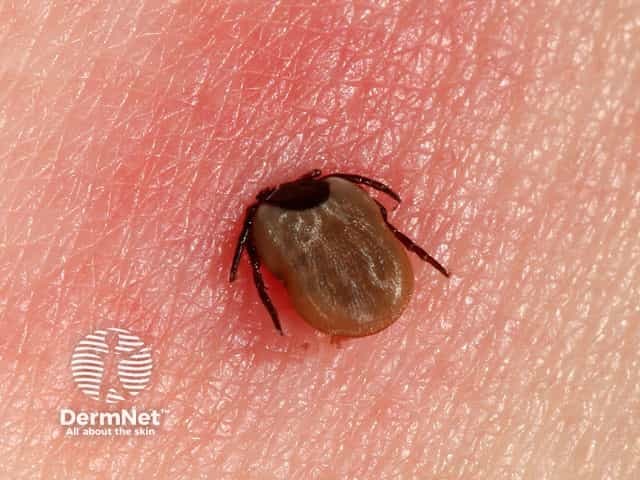
Ixodes tick - image sourced from DermNet.

Additional Detail: Signs & Symptoms of Lyme Disease

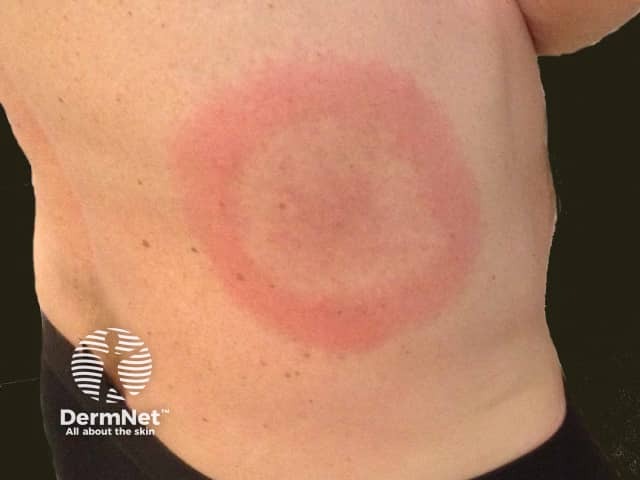
Patients with erythema migrans should be diagnosed with and treated for Lyme disease.  Erythema migrans is often referred to as a “bulls-eye” lesion presenting as a well-defined, spreading flat, red, and circular rash with concentric central sparing and redness.  It is usually present at the site of the tick bite and can appear after several days and up to three weeks - four months after.  It is not usually painful, hot, or itchy.

Erythema Migrans - image sourced from DermNet.

Alternatively, it can present without a bulls-eye / target appearance, may be red or blue in colour with a raised centre, and may not necessarily be circular shaped.  The appearance of this rash can vary by causative species and geographical region.  Disseminated disease can result in multiple smaller erythema migrans rashes distant to the original bite site.

Other non-focal signs and symptoms, particularly in early disease could include:

Joint, muscle pain, and/or paraesthesia.

Fatigue, lethargy, or malaise.

Fevers and sweats, or lymphadenopathy.

Generalised flu-like symptoms

Headache, migraine, or neck pain / stiffness.

Cognitive impairment, memory-issues, and difficulty concentrating.

Syncope.

Focal signs and symptoms may present in disseminated or late stage disease:

Eye symptoms; uveitis or keratitis.

Cardiac problems; palpitations, heart block, arrhythmias, pericarditis.

Mono/poly arthropathy; fluctuating and migratory inflammatory arthritis.

Neurological presentations; bell’s palsy (or other CN palsy), radiculopathy, mononeuritis multiplex, meningitis, encephalitis, psychiatric disorders.

Cutaneous manifestations; Borrelial lymphocytoma (painless blue-red nodule which often affects the ear lobe, scrotum, or nipple), Acrodermatitis chronica atrophicans (a progressive and atrophic red-blue lesion that presents in the extremities as a consequence of late stage infection). 

Additional Detail: Investigations for Lyme Disease

Lyme disease can be diagnosed clinically in the presence of erythema migrans.  If this is not present but Lyme disease is suspected then laboratory investigations should be used in the diagnosis.

Depending on the deployment and area of operations laboratory testing may not be available, may be delayed, and/or not accredited to a UK/NHS standard.  In this case, if Lyme disease is suspected with good reason (e.g. tick exposure and non-focal / focal symptoms), it may be beneficial to prescribe a course of appropriate antibiotics. Likewise, if Lyme disease is highly suspected, then antibiotics may be prescribed whilst awaiting testing results.

Testing may provide false negatives if performed early in the disease as blood antibody levels may not be sufficiently high enough to provide a positive result.  This may also be the case for those that are immunosuppressed.  ELISA testing may also test positive in non-current disease if it detects antibodies from previous infection, hence the need for a subsequent ImmunoBlot test to confirm the diagnosis.

Testing follows a two-tier approach (taking advantage of the varying sensitivity and specificity of the tests):

Initial testing with an ELISA test.

Then, if the ELISA test is positive or equivocal an ImmunoBlot test is performed.

If this is positive a diagnosis of Lyme disease can be made and antibiotic therapy started.

In the case of negative tests:

If the initial ELISA test is negative then a repeat test can be offered at 4-6 weeks.  If symptoms have persisted for 12 weeks then an ImmunoBlot test should be performed.

If the ImmunoBlot test is negative then an alternative diagnosis should be considered or expert/specialist opinion sought if Lyme disease is still suspected.

If the ImmunoBlot test is negative and presenting signs & symptoms have resolved then no further action is required.

NICE guidance offers a helpful visual summary of the decision process that is available here.

Other investigations may be indicated depending on mode of presentation although not all may be practical or possible in the deployed environment.  Routine bloods including FBC, CRP, renal function (+/- extended electrolytes) and liver function tests may be useful if there is diagnostic uncertainty or co-infection suspected.

Likewise, screening tests for patients with pyrexia might include plain film chest radiography, dipstick urinalysis, and blood cultures.  ECG may help screen for cardiac abnormalities such as arrhythmias and heart blocks.

If focal symptoms are present, then specialist advice should be sought to guide additional investigations. These may include:

Lumbar puncture if neurological symptoms are present.

Joint aspiration if arthralgia is present.

Echocardiography if cardiac abnormalities are present.

Magnetic resonance imaging of the head may also be considered.

Additional Detail: Management of Lyme Disease

Oral antibiotics should be prescribed as detailed above. Consult deployed antimicrobial guidance for additional advice. 

Follow-up should be arranged, when possible, to ensure resolution of symptoms.

If symptoms persist then a second course with an alternative antibiotic to that initially prescribed should be considered.  If a second course fails then specialist advice should be promptly sought.

Certain symptoms or affected systems may warrant a course of intravenous Ceftriaxone (2 grams, once daily). This would be appropriate:

For 21 days in Lyme disease affecting the central nervous system or in Lyme disease with carditis and haemodynamic instability (with Doxycycline as an appropriate oral switch).

In those with carditis but no haemodynamic instability, as an alternative antibiotic, for 21 days.

As an alternative antibiotic for 28 days in Lyme disease with arthritis or acrodermatitis chronica atrophans.

Patients with focal symptoms should receive relevant specialist review (e.g. infectious diseases, neurology, rheumatology, cardiology) when possible and practicable.  

Last reviewed: 13/10/2026

Next review date: 13/10/2027

Related resources