
Paracetamol Overdose

Warning

Objectives

To guide the management of patients at risk of paracetamol poisoning in the deployed setting.

Scope

This CGO will provide guidance on the initial risk assessment, investigation and management of patients who may have been exposed to a potentially toxic dose of paracetamol (acetaminophen). The management of severe liver failure is not included. 

This guideline does not provide advice on assessing the mental health of patients who may have taken a deliberate overdose of paracetamol or attempted to harm themselves by other means. Please consult the CGOs on mental health for guidance on this aspect of patient care.

This guideline only applies in the deployed setting due to limitations in deployed laboratory testing. It should not be used in the Firm Base or when access is available to TOXBASE® and UK equivalent laboratory testing for paracetamol concentrations, liver function tests and International Normalized Ratio (INR).  

Audience

This guideline is intended for the use of registered healthcare professionals fulfilling a general role in forward medical locations or in an Emergency Department on deployed operations.

Initial Assessment & Management

The deployed management of paracetamol overdose differs from normal practice in a civilian or Firm Base setting due to the lack of deployed plasma paracetamol assays and limited access to other blood investigations.  


Risk of Toxicity

The risk of toxicity and need for investigation and treatment varies dependent on the total dose of paracetamol, the timing of the overdose and why it was taken. 

Clinical history:

  • What substances ingested? Single or combined preparations? Immediate or slow release? 
  • How many tablets and what strength tablets? What is the total dose in mg/kg? 
  • Time of ingestion. All tablets taken in less than one hour, over several hours, or days? 
  • Why was the overdose taken e.g. self-harm (intentional) or treating pain (therapeutic)?


Clinical Features of paracetamol toxicity: 

  • Hepatotoxicity: 
    • Early: nausea +/- vomiting and abdominal pain
    • After 12-36 hours: features of hepatic necrosis - right subcostal pain, hepatic tenderness, jaundice, confusion, reduced consciousness
    • Clotting derangement increases risk of bleeding. 
  • Acute kidney injury: Loin pain, haematuria, proteinuria
  • Massive overdose: reduced consciousness, metabolic acidosis, lactatemia.


Categorise the patient and refer to the appropriate section below:

  • Acute: An overdose taken over a period of one hour or less
  • Staggered: a deliberate overdose (taken over more than one hour)
  • Therapeutic: an accidental overdose taken to treat pain or fever without self-harm intent.


Patients who have meet the criteria for treatment with N-acetylcysteine (as described below) OR who have clinical features of paracetamol toxicity should be evacuated without delay to a facility able to initiate treatment.

ACUTE OVERDOSE 

An overdose taken over a period of one hour or less.

When to treat with N-acetylcysteine (NAC): 

  • Adult or child 6 years or over. If less than 75 mg/kg ingested AND asymptomatic. Serious toxicity is unlikely and treatment with NAC is not required. Consider mental health assessment.
  • Child 5 years or younger. If less than 150 mg/kg ingested AND asymptomatic. Serious toxicity is unlikely and treatment with NAC is not required.
  • If there is uncertainty about the dose or time of ingestion then as a general principle start treatment. 
  • If symptomatic OR total dose of 75 mg/kg or more (150 mg/kg if 5 years old or less) N-acetylcysteine (NAC) treatment is required (dosing below). 
All patients requiring treatment should be evacuated to an appropriate medical facility at which N-acetylcysteine can be administered. For maximal protection NAC should be started within 8 hours of ingestion. 


STAGGERED OVERDOSE 

This applies to all age groups.

A staggered overdose is an ingestion of excessive paracetamol over a period greater than one hour, which was not taken for therapeutic (pain or antipyretic) intent. 

The risk associated with a staggered overdose may be uncertain and difficult to determine, so in all staggered overdoses, the patient should start NAC as soon as possible unless confident that the ingested dose has not exceeded the licensed dose (in adults, 4g in 24h).

All patients requiring treatment should be evacuated to an appropriate medical facility at which N-acetylcysteine can be administered without delay. 

If attempting to determine the risk associated with delayed evacuation, note that ingestions of less than 75 mg/kg in a 24-hour period are very unlikely to be toxic although the risk is thought to increase if the dose is repeated over two or more days. 


THERAPEUTIC OVERDOSE

This applies to all age groups.

A therapeutic overdose is an ingestion of paracetamol over the licensed daily dose AND 75 mg /kg or more within 24 hours, taken for the treatment of pain or fever without intention to self-harm. However, there is a very small risk of hepatotoxicity if less than 75 mg/kg/24 hours is ingested over 72 hours or more (see below regarding poor nutrition and high-risk groups). 

NAC should be commenced if over the licensed daily dose AND ≥ 75 mg/kg/24 hours has been ingested.

All patients requiring treatment should be evacuated to an appropriate medical facility at which N-acetylcysteine can be administered without delay. 


Advanced Assessment & Management

BLOOD TESTS

Note that in acute overdose the administration of NAC would usually wait for blood results. However, as blood paracetamol concentration is not available in the deployed setting, NAC should be started as soon as possible once the risk of toxicity is identified.

For staggered overdose or therapeutic overdose, blood paracetamol concentration is not used to determine whether NAC is indicated even if the test is available.

If possible, blood samples should be taken for VBG, FBC, U&E, LFTs and PT at least 4 hours after the last paracetamol ingestion. Baseline bloods and any subsequent repeat testing may assist clinical decision making and provide early indication of deteriorating liver or kidney function.


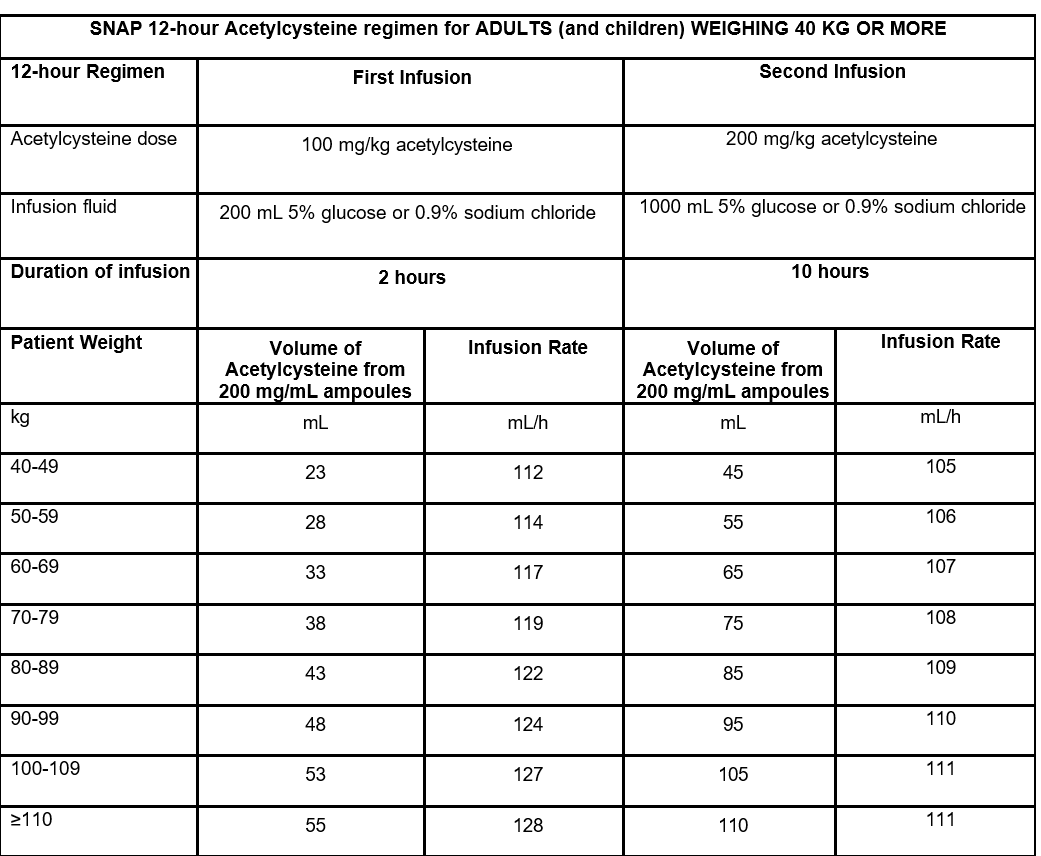
ACETYLCYSTEINE DOSES & MANAGEMENT (>40kg)

The 12-hour ‘SNAP Protocol’ for Acetylcysteine (NAC) should be used. This consists of two sequential infusions: 

Adults and children weighing 40 kg or more: 

1st bag: Acetylcysteine 100 mg/kg body weight (max 11 g) in either 200 ml 5% glucose or 0.9% sodium chloride. Infuse over the first 2 hours.

2nd bag: Acetylcysteine 200 mg/kg body weight (max 22 g) in either 1000 ml 5% glucose or 0.9% sodium chloride. Infuse over the next 10 hours.

Following completion of the second bag, consult the guidance below for further advice.

Additional notes:

  • For adults weighing less than 39kg use the NAC treatment regime in the 'Paediatric Considerations' section of this CGO.
  • If neither intravenous nor intraosseous access can be established, the intravenous preparation of N-acetylcysteine can be administered orally (see below).
  • Anaphylactoid reactions to N-acetylcysteine are not uncommon. For information on managing adverse reactions to NAC see the accordion content below.

Prolonged Casualty Care

Risk assess the patient as described above. The risk of severe liver damage increases with the dose ingested. Paracetamol poisoning requires treatment with acetylcysteine (NAC) as soon as possible. If evacuation to a location with NAC is not possible, maintain good hydration with intravenous crystalloid, administer antiemetics as required and reassess the patient regularly.

If NAC is not available, fomepizole may be considered to delay conversion of paracetamol to toxic metabolites. 

Paediatric Considerations

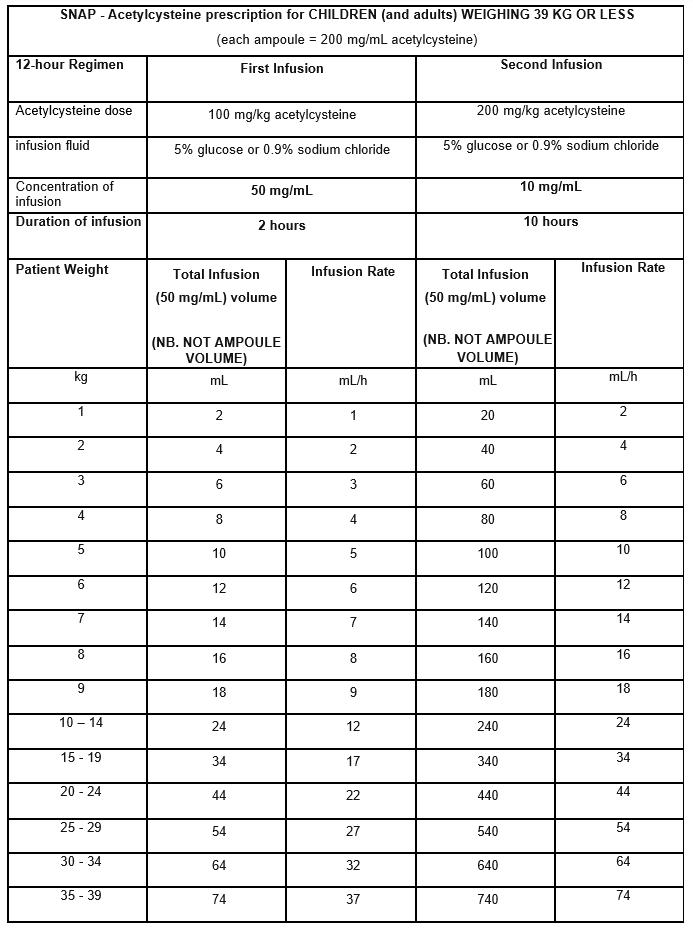
ACETYLCYSTEINE DOSES & MANAGEMENT (≤39kg)

Children (and adults) weighing 39 kg or less: 

1st bag: 

  • Prepare a 50 mg/ml acetylcysteine stock solution. Dilute each 10 ml ampule (containing 200 mg/ml acetylcysteine) with 30 ml 5% glucose or 0.9% sodium chloride, giving a total volume of 40 ml. 
  • Administer acetylcysteine 100 mg/kg body weight over 2 hours e.g. 16 ml stock solution for an 8 kg child 

2nd bag: 

  • Prepare a 10 mg/ml acetylcysteine stock solution. Dilute each 10 ml ampule (containing 200 mg/ml acetylcysteine) with 190 ml 5% glucose or 0.9% sodium chloride, giving a total volume of 200 ml.
  • Administer Acetylcysteine 200 mg/kg body weight over the next 10 hours e.g. 160 ml stock solution for an 8 kg child.

Following completion of the second bag, consult the guidance below for further advice.

Management of patients on completion of the 12-hour NAC regimen

If there is any doubt as to the total dose ingested or concern regarding patient symptoms then NAC should be continued (3rd bag) at the dose and infusion rate used in the second bag (10 hour). 

Bloods: if available re-check ALT, U&Es, PT (or INR), paracetamol concentration. Bloods should be taken after the 2nd bag has finished. Results from bloods taken whilst the infusion is running may underestimate paracetamol concentrations or overestimate the INR. 


Requirement for 3rd infusion - WITHOUT ALT and / or paracetamol concentrations:

If ALT and paracetamol concentrations are not available at the end of the 12-hour regimen then NAC maybe stopped if

  • less than 150 mg/kg paracetamol has been ingested

         AND

  • the patient has no symptoms of hepatotoxicity or acute kidney injury. 

         AND

  • available blood results e.g VBG,FBC, U&E, PT are normal.

Patients should then be observed for a further 12 hours and NAC restarted if symptoms develop. 

If these criteria are not met, NAC should be continued at the dose and infusion rate used in the second bag (10 hour). 


Requirement for 3rd infusion when ALT and paracetamol concentrations available

NAC should be continued if ANY of the following criteria are met (continue NAC at the dose and infusion rate used in the second bag (10 hour): 

  • The ALT is above the upper limit of normal range

         OR

  • The ALT has doubled or more from admission (even within the normal range) 

         OR

  • The paracetamol concentration is greater than 10 mg/L


Management of Patients receiving 3rd bag or more. 

In the deployed setting any patient with features of hepato-toxicity and/or renal toxicity should receive additional infusions (bags) of NAC at the same dose and rate as the 2nd (10-hour) bag, until they can be evacuated to a location with appropriate laboratory capabilities.

Bloods: Recheck ALT, U&Es, INR at the end of each 10-hour bag. There is no need for paracetamol concentrations unless this was available and raised > 10 mg/L after the 2nd bag. 

End of 3rd Bag (22 hours) - criteria to continue NAC if ANY of the following are present:

  • ALT more than two times the upper level of normal

        OR

  • ALT above upper level of normal AND increased from previous result AND more than doubled since admission

        OR

  • PT is above upper level of normal AND increased from previous value AND the ALT is above the upper level of normal. 


End of 4th or subsequent bags – criteria to continue NAC

After the 4th bag the decision for further NAC requirement is made on the INR (PT) alone. NAC should be continued until: 

  • PT is normal (or INR is less than 1.3) 

         OR

  • PT is falling towards normal on two consecutive blood tests and is less than (INR 3.0)


Patients who do not meet the criteria for further NAC can be discharged. 

Acetylcysteine oral administration

In the complete absence of intravenous (IV) or IO access oral NAC may be administered using the IV preparation (unlicenced). The taste of NAC is very unpleasant and can be masked with fruit juice or alternative flavoured drink. A nasogastric tube may be used to facilitate administration. 

Every effort should be made to administer NAC IV prior to oral administration. 

If oral NAC is required reach-back advice should be obtained.


Oral NAC dose:

  • Loading dose: 140 mg/kg given as a 50 mg/mL solution diluted with juice/cola or water.
  • Maintenance doses: 70 mg/kg as a 50 mg/mL every 4 hours. Check bloods at 24 hours and review need for further therapy.


Adverse Reactions to Acetylcysteine

NAC may cause anaphylactoid reactions. These are more likely to occur at lower paracetamol concentrations, in women, patients with a family history of allergies and people with asthma or atopy. 

Previous anaphylactoid reactions to NAC do NOT contraindicate treatment with intravenous NAC in patients with paracetamol overdose if NAC is clinically indicated. Consider pre-treatment with chlorphenamine 10 mg IV and, if previous bronchospasm, nebulised salbutamol. 

Features: 

  • Common: nausea, vomiting, flushing, urticarial rash, angioedema, tachycardia, bronchospasm.
  • Uncommon: hypotension and collapse.

Anaphylactoid reactions are dose-related and most commonly occur during or soon after the first bag infusion. 


Management of adverse reaction to NAC: 

1.    Temporarily stop the NAC infusion. 

2.    Consider chlorphenamine 10 mg IV and nebulised salbutamol if bronchospasm present. 

Once the reaction has settled, restart the remaining NAC at half the infusion rate e.g administer the 1st bag over twice as long. Subsequent bags should be given at the normal rate. 

Special Circumstances

Intravenous Overdose

A lower treatment threshold is used for IV paracetamol overdose: administer NAC using the protocol described above to all patients who have received more than the licensed dose and 60 mg/kg or more within any 24-hour period. 

Massive Overdose

Renal replacement therapy (RRT) may be considered in massive overdose presenting as reduced consciousness and lactatemia, (paracetamol concentration >700 mg/L, if available). If RRT is available then NAC should be administered concurrently and the dose of NAC doubled. 

Pregnant patients

Use pre-pregnancy weight (up to maximum 110 kg) to calculate the exposed paracetamol dose, but use current (pregnant) weight for acetylcysteine dosing.  

Pregnant patients should be managed as non-pregnant patients. Available data does not suggest in increased risk of congenital malformation or fetal loss in the absence of severe toxicity. Delayed treatment of the mother is linked to increased fetotoxic effects.

Obese patients

Use a maximum body weight of 110kg to calculate the exposed paracetamol dose and acetylcysteine dose. If less than 110kg use actual body weight. 

Higher Risk Patients

Patients with poor nutritional status, regular excessive alcohol consumption and/or long-term treatment with liver enzyme inducing drugs may be at increased risk of toxicity, so the threshold for treatment with acetylcysteine should be lower. In practice, and without blood paracetamol concentration to guide management, a reasonable approach to such patients is to administer N-acetylcysteine irrespective of the size of overdose. 

Acute Kidney Injury (AKI)

AKI may occur with acute liver injury but does, rarely, occur in the absence of hepatic injury. Treat AKI as per the Acute Renal Injury CGO. Maximal abnormalities occur 3-7 days after exposure. Full recovery of renal function is the norm. 

Indications for referral to liver transplant unit

Patients with the following clinical features should be urgently evacuated and discussed with the firm base liver transplant facility:

  • Arterial pH less than 7.3 or bicarbonate less than 18 mmol/L, despite fluid resuscitation.
  • INR greater than 3.0 on day 2 or greater than 4.0 thereafter.
  • Oliguria and/or acute kidney injury.
  • Altered level of consciousness.
  • Hypoglycaemia.
  • Elevated lactate (>4 mmol/L) despite fluid resuscitation.
     

Last reviewed: 24/03/2026

Next review date: 24/03/2027

References

www.toxbase.org