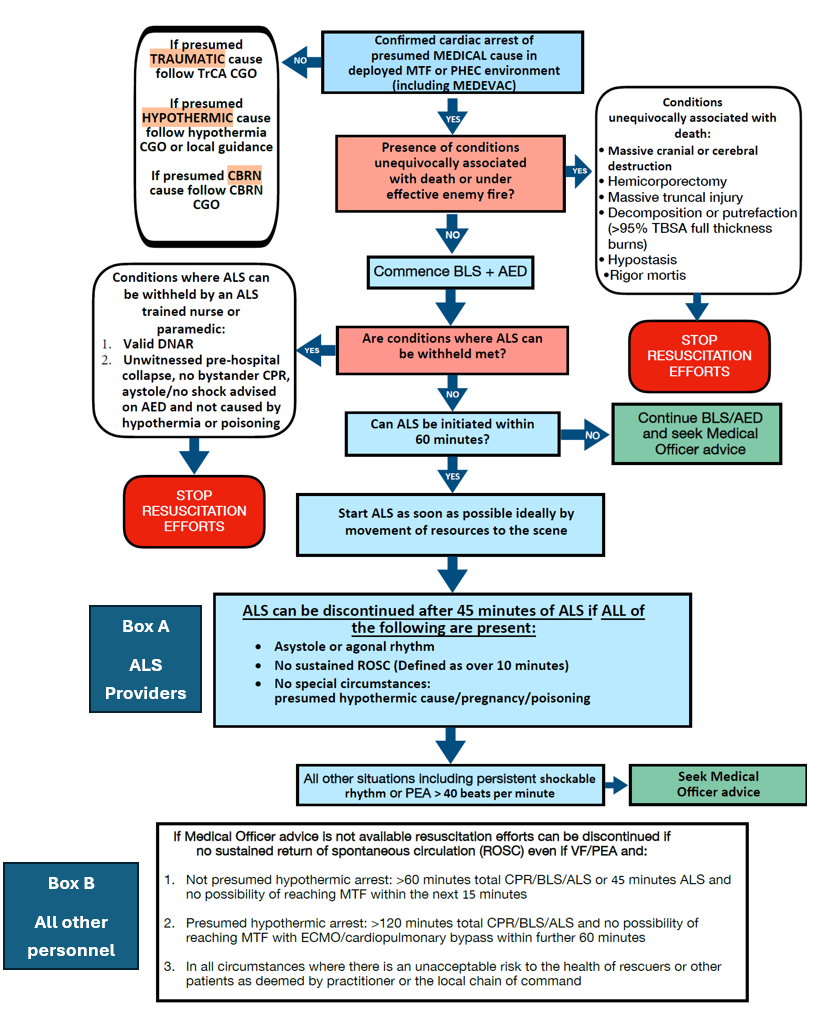
Cessation of Resuscitation in Adults - ROLE
Objectives
Objective: Cardiac arrest, even with effective cardiopulmonary resuscitation (CPR) has an overall low chance of good patient outcome either due to lack of a reversible cause or the effects of a sustained physiological insult. The burden of CPR on rescuers, bystanders and patients must be acknowledged, as well as the fact that it is unethical to start or continue a treatment which is not in the patient’s best interests. This guideline details the circumstances in which resuscitation attempts can be stopped or not initiated.
Scope
Recognition of circumstances where CPR can be stopped or not initiated.
Audience
This guideline is intended for the use of registered healthcare professionals fulfilling a role in a forward medical location or in an emergency department on deployed operations.
Initial Assessment & Management
Cessation of Cardiac Arrest ManagementMost cardiac arrests will not result in a Return of Spontaneous Circulation (ROSC). All clinicians should be aware that despite this the cessation of CPR can be challenging. The underlying pathology may not be clear, and bystanders are likely to be colleagues and friends of the patient. Clinicians must be prepared to deal with both challenging decision making and heightened emotions requiring the situation to be managed with sensitivity. Throughout, the emphasis must remain on the patient; provide the best care while there remains a realistic chance of meaningful recovery but manage death with dignity.
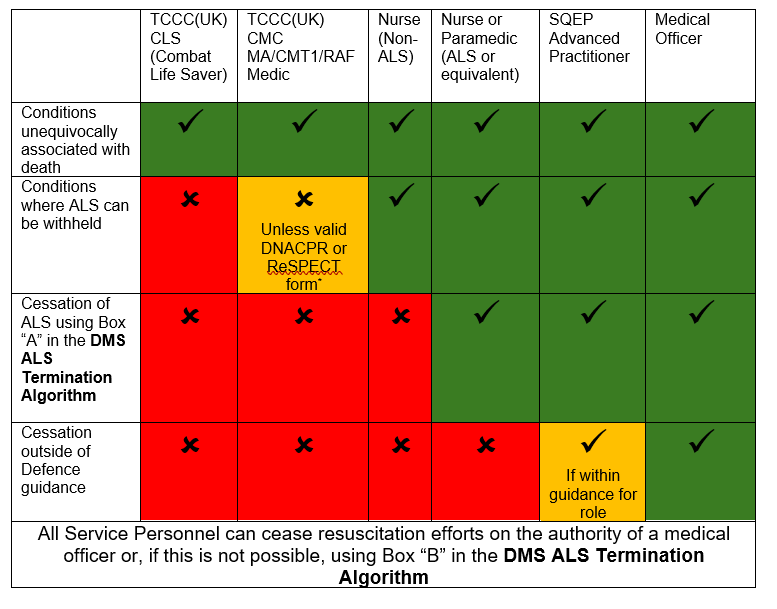
The below table summarises the clinical capability of the service person leading the cardiac arrest and when resuscitation can be discontinued. The majority of personnel are advised to seek medical officer support to cessation outside the guidance described below.
Withholding Advanced Life Support
ALS would be futile if ALL of the following exist together:
a) The patient is a non-pregnant adult
b) More than 10 minutes has elapsed since the onset of collapse.
c) No evidence of bystander CPR in the 10 mins before the arrival of the medical personnel
d) Asystole/no shock advised by AED. (Ideally a printout is needed when not on ops)
e) None of the following are suspected as the cause for cardiac arrest
i. Drowning (unless submerged for > 60 minutes)
ii. Hypothermia (see hypothermia CGO)
iii. Poisoning/overdose
In all other circumstances resuscitation should be commenced unless there are conditions unequivocally associated with death or a valid Do Not Attempt Cardiopulmonary Resuscitation (DNACPR) or ReSPECT (Recommended Summary Plan for Emergency Care and Treatment).
All conditions listed below are unequivocally associated with death in all age groups. In the presence of one or more of the following, CPR should not be commenced. If it has been started by others, it should be ceased.
a) Rigor mortis - The stiffening of the body including limbs which are difficult to move or manipulate. Occurs fastest in the jaw/neck muscles. This can occur a few hours after death and can last approximately 24 – 48 hours.
b) Hypostasis - blood is pulled by gravity to the lowest part of the body after the heart has stopped. The blood collects in the blood vessels at the lowest points on the body and the skin becomes a purple/red colour. This can become apparent from 20 minutes to 3 hours after death.
c) Massive Cranial or Cerebral Destruction (including decapitation) - Injuries to the skull and brain that are incompatible with life. This is defined as the presence of visible brain matter, or massive disruption to the head and face.
d) Traumatic hemicorporectomy - This is the traumatic removal of the lower half of the body.
e) Incineration - Defined as the presence of full thickness burns, with charring, greater than 95% of the body surface.
f) Decomposition/putrefaction - Decomposition is the breakdown of tissues after death. Putrefaction is part of decomposition where putrid, foul-smelling gases as produced by the decaying body.
Cessation of Advanced Life Support
If, following 45 minutes of ALS where all reversible causes have been addressed and the patient does not have sustained ROSC (defined of at least 10 minutes in duration) and remains in asystole or an agonal rhythm, resuscitation should be discontinued. The exception to this includes the following cases where evacuation resources are available to move imminently. These patients should be transported to the nearest appropriate MTF with on-going resuscitation, unless the circumstances would make evacuation impossible:
a) Pregnancy
b) Hypothermic patients (where hypothermia is the primary cause of the cardiac arrest)
c) Suspected drug overdose/poisoning
All other situations including persistent shockable rhythms or pulseless electrical activity (PEA) > 40 beats per minute should ideally be discussed with a Medical Officer.
a) If Medical Officer advice is not available resuscitation efforts can be discontinued if no sustained return of spontaneous circulation (ROSC) even if VF/VT:
i. Not presumed hypothermic arrest: >60 minutes total CPR/BLS/ALS or 45 minutes ALS and no possibility of reaching MTF within the next 15 minutes.
ii. Presumed hypothermic arrest: >120 minutes total CPR/BLS/ALS and no possibility of reaching MTF with ECMO/cardiopulmonary bypass within a further 60 minutes.
iii. In all circumstances where there is an unacceptable risk to the health of the rescuers or other patients as deemed by the practitioner or the local chain of command.
Body Management
In managing the body of the deceased, any medical equipment within the patient should be left in situ.
Medical personnel should liaise with the Quartermasters (QM) Department in the Firm Base, Firm Base overseas and deployed operational setting for the onward handling of the body. In the deployed setting where the QM department is not deployed, the local CoC should identify the correct pathway for body management through the organisation responsible for the deployment (for example, PJHQ).
Confirmation of Death
For medical teams, the following should be conducted to confirm death and documented (as detailed below). For a minimum of five minutes, confirm the absence of:
a) Carotid pulse on palpation
b) Heart sounds on auscultation
c) Respiratory signs on auscultation
d) Bilateral pupillary response
e) Bilateral corneal reflexes
f) Any motor response to supraorbital pressure
Documentation
Accurate medical record keeping is essential. Below is an outline of what should be included as a minimum:
a) Patient Details
-
-
- Location
- Date and time of event
- Patient details – Name, DOB
-
a) Resuscitation Summary
-
-
- Circumstances leading to collapse (witnessed/unwitnessed, monitored/unmonitored)
- Resuscitations interventions performed
-
b) Timeline
-
-
- Arrest recognition
- Time BLS/ALS commenced or time decision to not start resuscitation
- Any significant events during resuscitation- rhythms, drugs delivered etc
- Decision to stop resuscitation
-
c) Decision to Stop Resuscitation
-
-
- Who made the decision and if this was discussed with clinical reach back, who this was discussed with and their role
- Clinical rationale behind withholding or stopping resuscitation
-
d) Team members involved
-
-
- Names and roles of team members present
-
e) Confirmation of Death
-
-
- Name and role of the registered healthcare professional confirming death
- Document the absence central pulse, heart sounds, respiratory sounds, pupillary reflexes, corneal reflexes and motor response to supraorbital pressure, as appropriate.
-
f) Signatures
-
-
- Printed name, role, signature and registration number (applicable)
-
Large Scale Combat Operations (LSCO) and Challenging Operational Environments
These guidelines reflect the recent update for JRCALC and are designed to support all medical personnel working in any Defence location including the UK and deployed firm base. It is recognised that in some challenging operational environments or LSCO there will be situations where adaptations may be appropriate. This guideline supports the ability for Medical Officers to authorise different strategies based on clinical judgment and operational constraints either during reach back for a specific case or a documented local policy within the med plan signed off by the relevant CMA.
As always follow the values and standards of your service.
DMedC ALS Termination Algorithm